In the last days of March 1817, some four hundred Kandha (Khond) fighters from Ghumsur crossed into the former kingdom of Khurda, where they were joined by the paikas, the hereditary peasant soldiers of the Khurda kings, under the leadership of Buxi Jagabandhu Bidyadhar Mohapatra Bhramarbar Ray, the hereditary commander of the Khurda forces. Within days the rebels had sacked the police station and treasury at Banpur, overrun Khurda and driven the East India Company’s officers from the surrounding country. By 14 April they had entered Puri, where they proclaimed the restoration of the authority of the raja, Mukunda Deva II, and the Company’s officials withdrew to Cuttack. The rising spread across the coastal districts to Pipili, Gop, Kujang, Harishpur and Pattamundai, drawing in paikas, peasants, zamindars and temple servants. The Company responded with martial law, punitive columns and the burning of villages, and by the end of 1817 it had regained control of the towns and plains; but Buxi Jagabandhu and his followers kept up resistance in the forests and hills for years, and he surrendered only on 27 May 1825. He died at Cuttack on 24 January 1829.
This article reconstructs the Paika rebellion of 1817, known in Odia as the Paika Bidroha, from its origins in the grievances created by the first fourteen years of British rule to its long aftermath in the reform of the Company’s administration of Odisha. It examines the life and leadership of Buxi Jagabandhu, whose loss of his hereditary estate of Killa Rorang gave the discontent of the paikas a leader; the political, economic, social and religious causes of the rising; its course and spread through the coastal districts; the methods by which the Company suppressed it; the inquiry and reforms that followed; and the fates of the rebel leaders and the Khurda royal family. It then considers how the rebellion has been interpreted by colonial and Odia historians and remembered in Odisha, culminating in the campaign, during and after its bicentenary in 2017, to have it recognised as India’s “first war of independence”.
The argument of the article is that the Paika rebellion was a broad-based popular rising, rooted in the specific grievances of the paikas of Khurda but drawing support from many sections of Odia society that had suffered from the early colonial order: dispossessed zamindars, cultivators burdened by over-assessment and the demand for silver, salt makers and consumers hit by the salt monopoly, and Odias resentful of the dominance of outside officials. Its suppression confirmed the military supremacy of the Company, but its scale forced the Company to recognise the failures of its administration and to undertake reforms that changed the character of British rule in Odisha. In this sense, the rebellion was both the last great act of resistance by the old order of Khurda and the beginning of a new relationship between the colonial state and Odia society.
Table of Contents
1. Introduction and background
1.1 Khurda after 1805
The rising of 1804–05 ended the independent existence of the kingdom of Khurda, which for more than two centuries had preserved the inheritance of the Gajapati empire in the hills and forests south-west of Cuttack. After the defeat of the Khurda forces near Pipili in November 1804, the capture and destruction of the fort in December and the arrest of the raja in January 1805, the Company annexed the kingdom outright. It was not handed over to a zamindar or returned to its ruler on new terms, but placed under direct management as a khas mahal, a government estate administered by the Company’s own officers, who collected its revenue and governed its villages in place of the raja’s servants. Jayi Rajguru, the learned minister who had directed the rising, was tried and executed at Baghitota near Midnapore in December 1806. The raja, Mukunda Deva II, was treated with calculated leniency: released after blaming his minister for the rising, he was allowed to settle at Puri with his royal title and an allowance, and in 1809 he was appointed hereditary superintendent of the Jagannatha temple. The Company had thus destroyed Khurda as a political power while preserving its royal house as a ritual institution useful for the management of the temple (see Khurda Rebellion of 1804 and Jayi Rajguru).
The settlement after 1805 removed the political authority of the Khurda court, but it did not remove the society that had sustained that authority, nor the loyalties that bound it together. The villages of Khurda were still full of paikas, still organised under their hereditary leaders, still conscious of their identity as the soldiers of the Gajapati, and still loyal to the memory of the kingdom and of the minister who had died for it. The raja at Puri, though stripped of his territory, remained a figure of immense prestige throughout Odisha, the first servant of Jagannatha and the living link with the great Gajapati kings of the past. The grievances that had produced the rising of 1804, the Company’s refusal to restore Khurda’s lost parganas, its disregard for the kingdom’s traditions and its humiliation of the royal house, had not been addressed. They were now compounded by the experience of direct Company rule. The administration of the Khurda estate in these years is associated in the sources with Major Fletcher, under whom the revenue was assessed heavily, the old tenures and privileges of the kingdom were systematically dismantled, and the collection of revenue was entrusted to subordinate officials who were frequently outsiders with little understanding of, or sympathy for, the society they governed. The result was that Khurda, far from being pacified by the defeat of 1805, became over the following decade the most disaffected region of the province.
1.2 The paikas under Company rule
The paikas were peasant soldiers who held rent-free lands, or jagirs, in return for military service to the raja. They were not a professional standing army but a militia rooted in the village: in time of peace they cultivated their lands like other peasants, and in time of war they assembled under their local commanders, armed with swords, shields, matchlocks and bows, to fight for their king. Organised in a hierarchy of hereditary leaders and divided by their arms and functions, they had formed the backbone of Khurda’s power for more than two centuries, defending the kingdom against Afghan, Mughal and Maratha attempts to subdue it, and making the forests and hills around the fort of Khurda a place that invaders entered at their peril. Their service was a matter of honour as well as obligation. Their land, their status above ordinary cultivators and their sense of identity as the soldiers of the Gajapati all depended on the existence of a kingdom that needed and rewarded their service.
The Company had no need for a militia whose loyalty lay with the raja and which had fought against it in 1804. From its point of view, the paikas were at best an anachronism and at worst a standing threat to public order, and their rent-free lands represented revenue that the state was entitled to collect. Over the following years the paikas’ service lands were accordingly resumed and brought under assessment, and the paikas were reduced to the status of ordinary cultivators, paying revenue on lands their families had held free for generations. Some, unable to pay the new demand, lost their lands altogether to purchasers or to the state. The loss was not only economic. The paikas lost the military role and the honour that had distinguished them from other cultivators, and they found themselves exposed to the demands of revenue officials, police and moneylenders whom they regarded as outsiders and social inferiors. A class that had once been the armed guardians of a kingdom became, within a few years, a dispossessed and humiliated peasantry. Their resentment, sharpened by the memory of Jayi Rajguru’s execution and by the presence among them of their former commander, now himself dispossessed, made them the natural core of the rebellion of 1817.
1.3 The Company’s Odisha, 1805–1817
The grievances of Khurda were part of a broader crisis of the early British administration of Odisha (see British Administration in Odisha). The Company governed the province under the Bengal Regulations, introduced in 1805, which imported into Odisha a system of revenue, law and administration designed for the very different conditions of Bengal. The officials who applied this system had little knowledge of Odia land tenures, little command of the Odia language and little inclination to adapt rules that were regarded in Calcutta as the most advanced in India. The result was a series of policies that bore heavily on almost every section of Odia society, as the following table summarises.
| Policy | Effect on Odia society |
|---|---|
| Short revenue settlements (1804–1815) | Repeated increases in the demand; arrears; no remissions for bad seasons |
| Bengal sale law | Sale of estates for arrears; transfer of land from old Odia families to outsiders |
| Payment in silver instead of cowries | Hidden increase in the burden of revenue on cultivators |
| Salt monopoly, tightened around 1814 | Higher price of salt for consumers; loss of independence for salt makers |
| Bengali subordinate officials and police | Extortion and corruption; Odias excluded from office |
| Resumption of paika lands | Paikas reduced to ordinary cultivators |
By 1817, therefore, the paikas of Khurda were far from alone in their discontent. Zamindars who had lost estates held by their families since Mughal or Maratha times, often to Bengali purchasers with connections in the revenue offices; cultivators burdened by repeated increases in the revenue demand and by the need to convert their cowries into silver at unfavourable rates; salt makers who had lost their independence and consumers who paid more for a daily necessity; temple servants who resented the Company’s control of Jagannatha’s affairs; and Odias of every class who resented the dominance of outsiders in the courts, offices and police stations, all had reasons to welcome a challenge to Company rule. These grievances were scattered and unorganised, and few of those who held them would have risen on their own. What the rising of March 1817 provided was a spark, a leader and a cause around which they could combine. The rebellion that began in Khurda drew on all of these discontents, and its rapid spread across the coastal districts in the weeks that followed shows how widely and how deeply they were felt.
2. Sources and historiography
The Paika rebellion is better documented than the Khurda rising of 1804, because it was larger, lasted much longer, affected a wider area and provoked a searching official inquiry into its causes. The volume of official correspondence generated by the rising, its suppression and its aftermath is considerable. But the documentation shares the same fundamental imbalance as the records of 1804. The great majority of contemporary documents were produced by the Company’s officers and officials, who saw the rebellion as a breakdown of order to be explained, suppressed and prevented from recurring, and who described its participants in the language of insurgency and crime. The voices of the rebels themselves survive only indirectly: in the statements they made after capture or surrender, often under interrogation; in the petitions of the Khurda royal family and of dispossessed zamindars, written to secure clemency or redress; and in Odia traditions, songs and stories recorded long after the events. A history of the rebellion must therefore read the official record critically, attending to what it reveals about the rebels’ motives and actions even when it does not intend to, and draw cautiously on the traditions that preserve the memory of the rebels, using them as evidence of how the rising was remembered as much as of what happened.
2.1 Military and administrative records
The reports of the officers and officials who confronted the rebellion, preserved in the consultations of the Fort William government and in the records of the Cuttack administration, provide the basic chronology of the rising and of the operations against it. They include the reports of the magistrate Edward Impey, who marched out of Cuttack against the rebels at the beginning of April 1817 and whose initial failure to contain them allowed the rising to spread; of the military officers who commanded the columns sent into Khurda and the coastal districts, among them Captain Le Fevre, Captain Wellington, Captain C. R. Kennet and Captain A. Macleod; of the Commissioner, W. Blunt, who directed the civil response; and of W. Wilkinson, later magistrate of Khurda, who dealt with the long aftermath. These documents record the movements of the rebels, the engagements fought, the proclamation of martial law, the capture of the raja and the trial and punishment of those taken. They are invaluable for establishing what happened and when. But they are written from the standpoint of men who regarded the rebels as insurgents, who had an interest in presenting their own conduct favourably, and whose methods, including the burning of villages, were in some cases themselves open to criticism.
2.2 The official inquiry
The scale of the rebellion, and the embarrassment it caused the government, led to the appointment of a special commission to inquire into its causes. The inquiry, associated with the name of Walter Ewer, examined the grievances that had driven the paikas and others into revolt, took evidence from officials and inhabitants, and reported on the failures of the administration. According to the accounts based on it, its findings included the excessive level of the revenue demand under the short settlements, the dispossession of old families through the sale of estates, the corruption and oppression of the subordinate officials and police, the hardship caused by the salt monopoly and the change from cowries to silver, and the injustice done to the paikas by the resumption of their lands. These findings are the most important single official source for the causes of the rebellion. They are significant not only for what they reveal about conditions in Odisha but for what they show about the government itself: confronted by a rising it could not attribute solely to the ambitions of a few malcontents, the Company came to acknowledge, in its own records, that its policies had provoked the revolt.
2.3 Rebel statements, petitions and surrender negotiations
The statements of captured rebels and the correspondence surrounding Buxi Jagabandhu’s eventual surrender provide rare glimpses of the rebels’ own perspective. The negotiations conducted on the Company’s behalf by the sheristadar Waz Mohammed, the rewards offered for the capture of the leaders, the deadline set for surrender and the terms of the pension eventually granted are all recorded, and they reveal something of how the rebel leader understood his position and what he sought in return for laying down his arms. The petitions of the Khurda royal family and of dispossessed zamindars, addressed to the Company in the years after the rising, record their grievances over land, revenue, status and the temple, and the claims they made for redress. These documents were produced under pressure, by people who needed the Company’s favour, and they cannot be taken as a full or free statement of the rebels’ aims. Nevertheless they reveal the rebels’ understanding of the injustices they had suffered, and they provide an essential counterweight to the reports of the officers who suppressed them.
2.4 Early British histories
Andrew Stirling’s Account of Orissa Proper, or Cuttack, written in 1822, only a few years after the rebellion and while Buxi Jagabandhu was still at large, offers the earliest considered British interpretation of the rising. Stirling, an official with a scholarly interest in Odisha, acknowledged some of the grievances that had produced it, but his account is shaped by the conviction that British rule had rescued the province from Maratha disorder. G. Toynbee’s A Sketch of the History of Orissa from 1803 to 1828 (1873), compiled half a century later from the records of the Commissioner’s office, gives the most detailed English narrative of the events of 1817 and of the long pursuit of the rebels that followed. Toynbee had access to correspondence that has since become difficult to consult, and his narrative remains indispensable for the chronology of the rising, though it views the rebellion entirely through the eyes of the administration and has little to say about the rebels’ motives.
2.5 Odia traditions
The memory of the rebellion was preserved in Odia oral tradition long before it was written down by historians. Songs and stories about Buxi Jagabandhu and the paikas circulated in the villages of Khurda and the coastal districts, celebrating the courage of the rebels and recording the suffering inflicted by the Company’s troops. In the late nineteenth and twentieth centuries these traditions were taken up in Odia literature and journalism, and the rebellion became a theme of patriotic writing and public commemoration. These traditions are essential for understanding how the rebellion was remembered and how it became a symbol of Odia resistance and identity. As evidence for the events themselves, however, they must be used carefully: they were transmitted orally over long periods, they reflect the concerns of the generations that preserved and retold them, and their details often cannot be verified against contemporary documents.
2.6 Key documents examined
| Document | Date | What it tells us | Limits |
|---|---|---|---|
| Reports of Impey and the military officers | 1817–1818 | Chronology of the rising; engagements; martial law; punishments | Written by those suppressing the rising |
| Report of the commission of inquiry (Ewer) | 1818 | Causes of the rebellion; failures of administration | Official perspective; framed to guide reform |
| Correspondence on Buxi Jagabandhu’s surrender | 1822–1825 | Terms offered; pension; the role of Waz Mohammed | Negotiating documents, not a full statement of rebel aims |
| Petitions of the Khurda royal family and zamindars | 1817–1820s | Grievances over land, revenue and status | Written to secure redress or clemency |
| Stirling, Account of Orissa Proper | 1822 | Early official interpretation of the rising | Strongly colonial perspective |
| Toynbee, Sketch of the History of Orissa | 1873 | Detailed narrative from official files | Official viewpoint; little on the rebels’ motives |
| Odia songs and traditions | 19th–20th century | Popular memory of Buxi Jagabandhu and the paikas | Recorded later; details unverifiable |
2.7 How the historiography developed
In the colonial accounts, from the reports of 1817 to Toynbee’s narrative of 1873, the rebellion appears as a “disturbance” or “insurrection”, a breakdown of order in a turbulent province. Its causes are attributed to a mixture of genuine administrative failings, the personal grievance and ambition of the dispossessed Buxi Jagabandhu, the intrigues of the Khurda royal family and the supposedly unruly character of the paikas. Even these accounts, however, could not ignore the failures of the administration that the official inquiry had exposed, and they generally acknowledge that over-assessment, the corruption of subordinate officials and the hardship caused by the salt monopoly had contributed to the rising. What they do not do is treat the rebellion as a legitimate expression of the political aspirations of Odia society.
Odia historians of the twentieth century, including Harekrushna Mahtab, Bhabani Charan Ray, K. M. Patra, Prafulla Kumar Pattanaik and Prasanna Kumar Mishra, transformed the interpretation of the rebellion. Reading the Company’s records against the grain and drawing on Odia sources and traditions, they placed the rising at the centre of the history of Odia resistance to British rule. They emphasised its broad social base, showing that it was not merely a revolt of a dispossessed military class but a rising that drew in peasants, landholders, temple servants and tribal communities. They traced its roots to the specific policies of the Company between 1803 and 1817, and they presented Buxi Jagabandhu not as a disappointed noble but as a national hero who led his people against foreign domination. Their work made the rebellion one of the defining episodes of Odia history.
Since the bicentenary of 2017, the rebellion has become the subject of a national debate. The government of Odisha, supported by many historians, political leaders and public figures, argued that the rebellion should be officially recognised as India’s “first war of independence”, preceding the uprising of 1857, which is conventionally given that title, by forty years. The demand attracted wide public attention and gave the rebellion a prominence it had never before enjoyed outside Odisha. The Union government did not adopt the designation, but in 2021 the rebellion was included in the NCERT history textbook for Class VIII as one of the first popular uprisings against British rule. The debate has stimulated new research, publications and commemorations, and it has also raised wider questions about how regional histories of resistance should be integrated into the national narrative of the struggle for independence, and about the criteria by which such risings are judged.
3. Buxi Jagabandhu: life and leadership
3.1 Family and office
Jagabandhu Bidyadhar Mohapatra Bhramarbar Ray was born, according to the usual account, in 1773 at Gadarondoga, in the Puri region, into an aristocratic family that had served the kings of Khurda for generations. His family held the hereditary office of bakshi (anglicised as “Buxi”), the commander of the Khurda forces, a rank described in the sources as second only to the king himself. The bakshi was responsible for the organisation of the kingdom’s military strength, for the mustering of the paikas in time of war and for the command of the army in the field, and the office carried with it great prestige and considerable wealth. The string of titles in his name, Bidyadhar, Mohapatra and Bhramarbar Ray, reflects the honours conferred on his lineage by the Khurda court over successive generations, and marks him as a member of the military aristocracy of the old kingdom, a class whose status and identity were inseparable from the existence of the Gajapati state. He grew up during the last decades of Maratha supremacy, when Khurda, reduced in territory but still independent in its own hills, preserved the traditions and institutions that the British conquest was soon to destroy.
The bakshi‘s position, like that of the paikas he commanded, was supported by land held in return for service. According to Mahanta’s account, the family’s jagir holdings included Buxibari and the estate of Killa Rorang, granted by the kings of Khurda in return for military service and held by the family for generations. These lands gave the family its income, its standing among the paikas and its role in the political and social order of the kingdom; they were the material foundation of its rank. As bakshi, Jagabandhu was the natural leader of the paikas: the officer to whom they looked for command, the guardian of their military traditions and the embodiment of the order that gave them their identity. When that order was destroyed, he and they shared the same fate, and the bond between them, rooted in generations of service, survived the destruction of the kingdom that had created it.
3.2 The loss of Killa Rorang
After the annexation of Khurda in 1804–05, Buxi Jagabandhu found himself the commander of an army that no longer existed, in the service of a king who no longer ruled. The Company’s revenue policy, under which rent-free military tenures were abolished and lands brought under regular assessment, struck directly at the foundation of his position. In 1814 his estate of Killa Rorang was taken over by the Company. A tradition widely repeated in Odia accounts holds that the estate passed, through the operations of the revenue system and the machinations of outsiders, into the hands of a Bengali speculator with connections in the revenue offices; the official records describe the loss in the impersonal language of revenue settlement, arrears and title. Whatever the precise mechanism, the result was that the hereditary commander of the Khurda forces, a man second only to the king in the old kingdom, was reduced to poverty and dependence on the charity of others, deprived of the lands that had sustained his family for generations. His appeals to the Company for the restoration of his estate were unsuccessful, and the refusal convinced him that there was no redress to be had within the system the Company had created.
The loss of Killa Rorang transformed Buxi Jagabandhu from a dispossessed aristocrat into a leader of revolt. His personal grievance was real and bitter, but it was also representative: the same revenue policy that had stripped him of his estate had stripped the paikas who once served under his family of their service lands. His humiliation mirrored theirs, and theirs his. In him, the scattered discontent of the paikas found a leader with the hereditary authority to command them, the military experience to organise them and a personal stake in the overthrow of the order that had ruined them all. The Company’s refusal to address his grievance in 1814 thus had consequences far beyond the fate of a single estate: it gave the paikas of Khurda the commander they needed to turn resentment into rebellion.
3.3 Leadership in 1817
Buxi Jagabandhu’s leadership of the rebellion combined the authority of his hereditary office with considerable political and military skill. He was able to mobilise not only the paikas of Khurda, who looked to him as their natural commander, but also the Kandhas of Ghumsur, a tribal people of the hill tracts whose own conflicts with the Company had left them hostile to its rule, and he drew in support from zamindars, temple servants and peasants across the coastal districts. Most importantly, he associated the rising with the Khurda royal house, proclaiming the restoration of the raja’s authority at Puri in April 1817. This gave the rebellion a legitimacy and a symbolic focus that extended far beyond the grievances of the paikas: it presented the rising not as the revolt of a dispossessed class but as the restoration of the rightful order of Odisha under the Gajapati, the servant of Jagannatha. In a society in which the Gajapati commanded deep loyalty, this was a powerful appeal.
He was supported by a group of lieutenants whose names are preserved in Mahanta’s account, among them Krushnachandra Bhramarabara Rai, his chief supporter, for whose capture the Company later offered a reward of its own; Rajballav Chhotrai; Narayana Paramaguru; Bamadeva Patajoshi; Damu Subudhi; and Gopal Chhotrai. Their diverse backgrounds, which included members of the Khurda military aristocracy and figures connected with the temple at Puri and with the Brahmin communities of the region, illustrate the breadth of the coalition Buxi Jagabandhu assembled. The rebellion was not the enterprise of a single disappointed noble, but of a network of leaders drawn from the different groups that had suffered under Company rule, held together by their common grievances and by their loyalty to the old order.
As a military leader, Buxi Jagabandhu understood the strengths and weaknesses of his forces. The paikas and Kandhas were most effective in surprise attacks, raids on isolated posts and the defence of difficult terrain, where their knowledge of the country and their mobility gave them the advantage; they were least effective in pitched battles against disciplined infantry supported by artillery. The opening weeks of the rebellion exploited these strengths to the full, striking at Banpur, Khurda and Puri before the Company could concentrate its forces. When the Company regained the initiative in the plains, Buxi Jagabandhu withdrew to the forests and hills of the interior, where he sustained resistance for years, moving among the tributary states of Nayagarh, Ranapur, Dasapalla and Baud and evading every effort to capture him. His ability to survive for so long, with a substantial price on his head and the Company’s troops in pursuit, testifies both to his own skill and to the support he continued to enjoy among the chiefs and villagers of the hill country, who sheltered him rather than betray him.
3.4 Surrender and death
The Company offered rewards for the capture of the rebel leaders: Rs 5,000 for Buxi Jagabandhu and Rs 2,000 for Krushnachandra. When these failed to produce results, it turned to negotiation, offering terms for surrender and setting a deadline of 1 December 1822. The negotiations, conducted on the Company’s behalf by the sheristadar Waz Mohammed, were protracted, and the terms were discussed at length. Eventually an agreement was reached. On 27 May 1825, more than eight years after the outbreak of the rebellion, Buxi Jagabandhu surrendered at Cuttack. He was granted a pension, initially discussed at Rs 200 a month and finally settled at Rs 150 a month, and lived thereafter at Cuttack under the Company’s supervision, a pensioner of the power he had fought. He died there on 24 January 1829. His surrender did nothing to diminish his reputation among Odias, for whom his long defiance mattered more than the terms on which it ended, and his memory has been honoured in Odisha in many ways, including the naming of the BJB (Buxi Jagabandhu Bidyadhar) College at Bhubaneswar.
4. Causes of the rebellion
The Paika rebellion had many causes, and its breadth reflects the range of grievances that fourteen years of Company rule had created in Odisha. No single grievance explains it: the paikas would not have risen without their leader’s personal injury and the memory of 1804, but the rising would not have spread across the coastal districts had it not touched the discontents of zamindars, cultivators, salt makers and temple servants. Historians have usually grouped these causes as political, economic, social and religious, and have distinguished them from the immediate circumstances that triggered the rising in March 1817. The distinction is useful, though in practice the causes reinforced one another. It is significant that the official inquiry that followed the rebellion itself accepted that many of these grievances were real and that the Company’s own policies bore much of the responsibility for the revolt; the causes outlined below are not merely the claims of the rebels or of later nationalist historians, but conclusions reached in large part by the colonial government itself.
4.1 Political causes
The deepest political cause was the destruction of the kingdom of Khurda. The annexation of 1804–05, the execution of Jayi Rajguru and the reduction of the raja to a pensioner at Puri had removed the political order to which the paikas, the Khurda aristocracy and much of the population of the region owed their loyalty. For more than two centuries the Gajapati of Khurda had been the focus of Odia political identity, the successor of the great kings of the past and the first servant of Jagannatha; his reduction to a dependant of a foreign trading company was felt as a humiliation not only by his own subjects but by Odias far beyond Khurda. The memory of the broken bargain of 1803, when Khurda had helped the British into Odisha only to be denied its reward, the refusal to restore the four parganas lost to the Marathas, and the execution of the minister who had sought redress, remained alive in the villages of Khurda. The rebellion’s proclamation of the raja’s authority at Puri in April 1817 shows that the restoration of the Khurda royal house, and with it of the political order it represented, was one of its central aims.
4.2 Economic causes
The economic grievances were the most widely shared.
- Resumption of paika lands. The paikas’ rent-free service lands were resumed and assessed for revenue, reducing a proud military class to ordinary cultivators and, in many cases, to poverty. This was the grievance that gave the rebellion its core of armed men.
- Over-assessment and the sale of estates. The short settlements of 1804–1815 raised the revenue demand repeatedly, with little knowledge of the productive capacity of the land and no remission for bad seasons. Estates that fell into arrears were sold under the Bengal sale law, often to Bengali purchasers with connections in the revenue offices. Zamindars and village headmen who had lost lands held by their families for generations had every reason to join a rising against the system that had dispossessed them.
- Cowries and silver. Under the Marathas much of the revenue had been paid in cowries, the small currency of the countryside. The Company’s insistence on payment in silver rupees forced cultivators to convert their cowries at market rates controlled by moneychangers and officials, increasing the real burden of taxation even where the nominal demand was unchanged.
- Salt. The extension and tightening of the salt monopoly, particularly from 1814, raised the price of salt, an indispensable daily necessity, for every household in the province, and deprived the salt makers of the coast of the independence they had enjoyed under earlier regimes.
- Closure of ports. According to Wikipedia’s summary of the causes, the Company closed four trading ports on the Odisha coast to protect its own commercial monopolies, damaging the local trade on which many coastal communities depended.
4.3 Social causes
The new administration brought with it a class of subordinate officials, clerks, police officers and revenue agents, many of them Bengalis familiar with the procedures of the Bengal courts and offices, who were regarded by Odias as outsiders and who were widely accused of extortion, bribery and abuse of their power. The police, in particular, were notorious for their exactions: the darogas who commanded the police stations had wide powers and little supervision, and their demands fell heavily on villagers who had no means of redress. The courts were distant, expensive and conducted in languages that most Odias could not understand, so that justice was accessible only through intermediaries who often had their own interests to serve. The exclusion of Odias from office and the dominance of outsiders created a pervasive sense of humiliation and injustice that extended well beyond the paikas and the dispossessed zamindars. It was this social grievance that gave the rebellion its character as a rising of Odia society against an alien administration, and it explains why the reforms that followed the rebellion included the opening of offices to Odias.
4.4 Religious and cultural causes
The Company’s control of the Jagannatha temple and its collection of the pilgrim tax were sources of resentment among the temple servants and the wider Hindu population. The appointment of the raja as hereditary superintendent of the temple in 1809 had restored part of the royal role, but the Company’s officers continued to oversee the temple’s affairs, and the spectacle of a Christian government taxing pilgrims to the shrine of Jagannatha offended many. More fundamentally, the humiliation of the Gajapati, whose position as the first servant of Jagannatha was the religious foundation of his kingship, was itself a religious as well as a political grievance. The participation of temple servants and Brahmins in the rebellion, among them several of Buxi Jagabandhu’s lieutenants, and the enormous significance of the rebels’ entry into Puri and their proclamation of the raja there, show that the rising had a religious dimension that strengthened its appeal and gave it a sacred legitimacy in the eyes of many Odias.
4.5 The Kandhas of Ghumsur
The immediate occasion of the rebellion was provided by the Kandhas of Ghumsur, in the Madras district of Ganjam on the southern border of Khurda. In March 1817 a body of some four hundred Kandhas crossed from Ghumsur into Khurda territory. The precise reasons for their movement are not fully clear from the surviving sources, but they were connected with the unrest in the hill tracts on the borders of Khurda and Ganjam, where the Company’s authority was weak and its relations with the hill communities were already strained, and with the Kandhas’ own grievances against the Company and its agents. Whatever their motives, their arrival provided the spark that the accumulated discontent of Khurda required. The paikas, under Buxi Jagabandhu, joined them, and the combined force began, at the end of March, the attack that opened the rebellion. The alliance between the paikas of the old kingdom and the Kandhas of the hills, communities with very different histories and ways of life, shows how widely the grievances against Company rule were shared, and it anticipated the later pattern of resistance in Odisha, in which tribal and peasant movements would play a central part.
| Cause | Who was affected | How it fed the rebellion |
|---|---|---|
| Destruction of the Khurda kingdom | Paikas, aristocracy, royal family | Restoration of the raja became a rallying cry |
| Resumption of paika lands | Paikas | Provided the core of the rebel forces |
| Over-assessment and estate sales | Zamindars, headmen, cultivators | Brought landholders into the rising |
| Silver instead of cowries | Cultivators | Spread discontent among the peasantry |
| Salt monopoly | Salt makers, all consumers | A universal grievance across the coast |
| Outside officials and police | All who dealt with the administration | Gave the rising a broad popular base |
| Control of the temple | Temple servants, Hindu population | Gave the rising a religious dimension |
5. The course of the rebellion, 1817–1825
The rebellion passed through three distinct phases, each with its own character. In the first, from the end of March to the middle of April 1817, the rebels held the initiative: they struck with speed and surprise, overran Khurda, defeated the Company’s first attempt to contain them and entered Puri, while the Company’s officials, taken unawares and lacking sufficient troops, withdrew to Cuttack. In the second, from April to the end of 1817, the Company brought in troops from other parts of its territories, proclaimed martial law and systematically recovered the towns and the plains, while the rising, in the meantime, spread to other parts of the coastal districts and the tributary states before being suppressed region by region. In the third, from 1818 to 1825, the rebellion became a guerrilla resistance: Buxi Jagabandhu and his remaining followers withdrew to the forests and hills of the interior, where they eluded the Company’s pursuit for years, until his negotiated surrender in May 1825. The drawing below sets out the main events of the first two phases, during 1817.
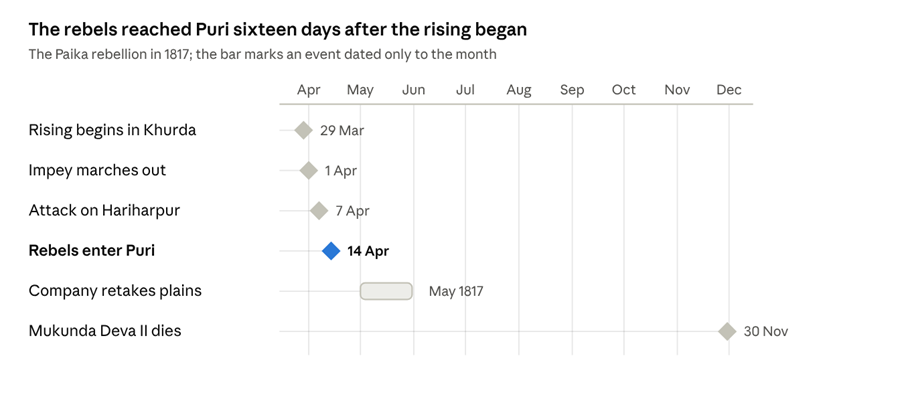
The rebels’ initial advance was extraordinarily rapid: they were in Puri just over two weeks after the outbreak, having overrun the whole of the country between Banpur and the sacred city. The Company’s recovery of the towns and plains, once it had concentrated its forces, took only a few weeks more, which shows how decisive the military imbalance became once disciplined troops were brought to bear. The struggle in the forests and hills, by contrast, lasted for years, and it was there that the rebellion’s leader proved most difficult to defeat.
5.1 The outbreak: Banpur and Khurda
The rising began on 29 March 1817, when the Kandhas of Ghumsur and the paikas of Khurda under Buxi Jagabandhu moved against the Company’s establishments in the former kingdom. Their first major target was Banpur, in the south of Khurda near the Chilika lake, where the Company had a police station, a post office and a treasury. The rebels attacked and destroyed these establishments, killed, according to Mahanta’s account, more than a hundred people, and carried off some Rs 15,000 from the treasury. The choice of targets was significant: the police station, the post office and the treasury were the most visible symbols of the Company’s authority and the instruments through which it governed and taxed the countryside. From Banpur the rebels marched north on Khurda, the heart of the old kingdom, where the Company’s officials and establishments were overrun, its subordinate officers killed or driven out, and its records and buildings destroyed. The speed and violence of the advance took the Company completely by surprise; its officials had not anticipated a rising on this scale, and they had no force in the region capable of resisting it.
5.2 The Company’s first response
News of the rising reached Cuttack quickly, and on 1 April 1817 the magistrate, Edward Impey, marched out towards Gangapara with the forces available to him in an attempt to confront the rebels and restore order. His force proved inadequate to the task. The rebels, far more numerous and operating in country they knew intimately, continued to advance, and Impey was obliged to fall back. On 7 April they attacked Hariharpur, extending the rising further across the country between Khurda and the coast. Near Pipili, on the road between Puri and Cuttack, Lieutenant Faris was shot and killed, one of the most notable British casualties of the rising. The Company’s officers in the region, isolated and outnumbered, withdrew towards Cuttack, and the rebels gained control of much of the country between Khurda and Puri. Within a fortnight of the outbreak, the Company’s authority in the southern part of the province had effectively collapsed.
5.3 Puri, 14 April 1817
On 14 April 1817 Buxi Jagabandhu entered Puri, the sacred city of Jagannatha and the residence of the raja, Mukunda Deva II. The rebels proclaimed the restoration of the raja’s authority as the Gajapati and the rightful ruler of the country, and the Company’s officials, unable to hold the town, withdrew to Cuttack. The entry into Puri was the high point of the rebellion. It gave the rising a religious and royal legitimacy of immense significance, associating it directly with Jagannatha and the Gajapati, the two most powerful symbols of Odia identity, and transforming it in the eyes of many Odias from a revolt of dispossessed soldiers into the restoration of the rightful order of Odisha. It also showed, more starkly than any other event of the rising, the extent to which the Company’s control of the province had collapsed: the most important town of southern Odisha, the centre of the pilgrim traffic and the seat of the temple whose management the Company had been so careful to control, had passed into the hands of the rebels.
The raja’s own role in these events remains uncertain, and it has been a matter of debate among historians. The rebels acted in his name and proclaimed his authority, and the Company regarded him as complicit in the rising, arresting him and his son when it recovered Puri. But whether Mukunda Deva II actively encouraged the rebellion, whether he merely acquiesced in what the rebels did in his name, or whether he was simply carried along by events he could not control, is not clear from the surviving evidence. His position was a difficult one: he owed his superintendence of the temple to the Company, but his prestige and his identity rested on the traditions of the kingdom the Company had destroyed. His death in custody later in the year meant that he never gave a full account of his conduct.
5.4 The spread of the rebellion
From Khurda and Puri the rebellion spread rapidly across the coastal districts. Rebels were active around Pipili, Gop, Kujang, Pattamundai, Harishpur and Praharajpur, and in the tributary states of Nayagarh and Ranapur on the western borders of Khurda. In many of these places the rising was not simply an extension of the Khurda rebellion but a local response to local grievances, in which zamindars who had lost their estates, temple servants, peasants burdened by the revenue and salt makers joined the paikas in attacking the Company’s establishments and officials. In several areas the rising took on the character of a general rebellion against the Company’s administration, directed against police stations, revenue offices and the subordinate officials who staffed them. Mahanta’s account records that the rising also reached as far as the territory of Rani Mukta Dei of Sambalpur, which was looted. The geographical spread of the rebellion, far beyond Khurda, is the clearest evidence of the breadth of the discontent on which it drew.
5.5 Martial law and suppression
The Company responded to the rising with overwhelming force once it had recovered from the initial shock. Troops were brought in from other parts of its territories, and martial law was proclaimed in Puri, Pipili, Lembai and other affected areas, suspending the ordinary courts and placing the population under military authority. Columns under officers such as Captain Le Fevre, Captain Wellington, Captain Kennet and Captain Macleod marched through the country, dispersing rebel bands, capturing their leaders and punishing the villages that had supported them. Le Fevre in particular was associated with the widespread burning of villages, a form of collective punishment intended to deprive the rebels of shelter and support and to deter others from joining them. The raja, Mukunda Deva II, and his son Ramachandra Deva were captured and taken into custody. By May 1817, according to the usual account, the Company had re-established control over the towns and the plains, though resistance continued in many places for the rest of the year. Captured rebels were tried, many of them by military courts under martial law, and sentenced to death, transportation or imprisonment, and the estates of rebel families were confiscated. The suppression was swift and severe, and it left a lasting memory of suffering in the villages of Khurda and the coastal districts.
Mukunda Deva II died in custody on 30 November 1817. He had been raja of Khurda for some two decades, had seen his kingdom annexed in 1805, his minister executed in 1806 and his authority restored only as a superintendent of the temple in 1809, and he died a prisoner of the Company after a rebellion fought in his name. His death ended any possibility of a restoration of the Khurda royal house as a political power, and it removed the symbolic centre around which the rebellion had been organised.
5.6 The long resistance, 1818–1825
Buxi Jagabandhu was never captured. After the Company regained the plains, he withdrew to the forests and hills of the tributary states that bordered Khurda to the west, moving among Nayagarh, Ranapur, Dasapalla, Baud and other places, supported by his remaining followers and sheltered by sympathetic chiefs and villagers who refused to betray him despite the rewards on offer. The difficult terrain, the dense forests and the fragmented political authority of the tributary states made him extremely difficult to pursue. In September 1818 he escaped from Baud when the Company attempted to seize him there. For years the Company conducted operations in the jungles against the remaining rebels, with limited success; its troops, trained for warfare in the open, were poorly suited to the pursuit of small and mobile bands in country their enemies knew far better than they did.
| Date | Event |
|---|---|
| September 1818 | Buxi Jagabandhu escapes from Baud |
| 1818–1825 | Company operations against rebels in the forests and hills |
| 1 December 1822 | Deadline set by the Company for surrender on terms |
| 27 May 1825 | Buxi Jagabandhu surrenders at Cuttack |
| 24 January 1829 | Buxi Jagabandhu dies at Cuttack |
Unable to capture him by force, the Company combined military pressure with offers of terms. Rewards were offered for the capture of the leaders, a deadline for surrender was set for 1 December 1822, and protracted negotiations were conducted through the sheristadar Waz Mohammed, a Company official who acted as intermediary. On 27 May 1825, more than eight years after the outbreak, Buxi Jagabandhu surrendered at Cuttack, accepting a pension of Rs 150 a month. He lived thereafter at Cuttack under the Company’s supervision until his death on 24 January 1829. His surrender brought the long resistance to an end, but it was a surrender on negotiated terms, not a capture, and it did nothing to diminish his standing among Odias as the leader who had defied the Company for longer than any other.
6. Aftermath: inquiry, reform and consequences
The Paika rebellion was suppressed, but it changed the Company’s government of Odisha in ways that the rising of 1804 had not. Its scale, its duration and, above all, the breadth of its support made it impossible to dismiss as the work of a few malcontents or the intrigue of a disappointed court. Senior officials in Calcutta were forced to ask why a province that had been conquered with so little resistance in 1803 had risen in arms fourteen years later, and the inquiry they ordered compelled the government to confront the failures of its own administration. The years after 1817 therefore saw a double response: on the one hand, the rebels were punished, their estates confiscated and the military class from which they came finally dismantled; on the other, the Company revised many of the policies that had provoked the rising, and the character of its rule in Odisha began to change.
6.1 Punishment
The immediate response was punitive, and it was intended to deter any repetition of the rising. Captured rebels were tried, many under martial law, and sentences of death, transportation overseas and imprisonment were passed. The estates of rebel families were permanently confiscated, extending the dispossession that had helped to cause the rising. The paikas, already stripped of their service lands, lost the last vestiges of their military status and were reduced finally to the condition of ordinary cultivators; the Company was determined that the military class of the old kingdom should never again be in a position to challenge it. Villages that had supported the rebels had already been burned during the campaigns of 1817. The Khurda royal family, whose name the rebels had invoked, lost its head when Mukunda Deva II died in custody in November 1817. In Khurda and the surrounding districts, the memory of these punishments remained alive for generations, and it became part of the popular tradition of the rebellion.
6.2 The inquiry
The government appointed a special commission, associated with Walter Ewer, to inquire into the causes of the rebellion. The commission’s task was not simply to assign blame but to understand why the rising had happened and how a recurrence could be prevented. Its findings, as reported in later accounts, acknowledged that the grievances of the rebels were real and substantial: the revenue demand under the short settlements had been excessive and had been enforced without regard to bad seasons; the sale of estates for arrears had dispossessed many old families in favour of outsiders; the subordinate officials and police had been corrupt and oppressive; the salt monopoly had raised the price of a necessity; the demand for silver had increased the burden of the revenue; and the paikas had been deprived of their lands without adequate provision. The inquiry thus confirmed, from the government’s own side, much of what the rebels had protested against with arms. Its conclusions are a remarkable instance of a colonial government acknowledging, in its own records, that its policies had provoked a rebellion against it.
6.3 Reforms
On the basis of the inquiry and of the experience of the rebellion, the Company introduced a series of reforms in Odisha. According to Mahanta’s account, these included:
| Reform | Effect |
|---|---|
| Administrative positions opened to Odias | Reduced the dominance of outside officials |
| Judicial proceedings held in interior villages | Brought the courts closer to the people |
| Reduction in the price of salt | Eased the burden of the monopoly on consumers |
| Revenue relief for struggling zamindars | Reduced arrears and estate sales |
| Ramachandra Deva III appointed to the management of the Jagannatha temple, with an annual pension of Rs 24,000 | Restored the royal family’s ritual role and secured its loyalty |
| Commissioner system restructured with expanded authority | Created a more effective provincial administration at Cuttack |
The administrative reorganisation of these years was part of a broader reform of the Company’s government of Odisha. In 1818 Cuttack became the seat of a Commissioner, a Revenue Board and a Provincial Court of Appeal, giving the province a stronger and more coherent administration with greater authority on the spot and less dependence on distant decisions in Calcutta. In 1828 the province was divided into the districts of Cuttack, Puri and Balasore, and in 1837, after a detailed survey, a long-term revenue settlement for thirty years replaced the short and destructive settlements of the early period (see British Administration in Odisha). These measures did not remove all the grievances of Odia society; the revenue demand remained high, the salt monopoly continued and outsiders remained prominent in the administration. But they marked a clear shift from the experimental and extractive administration of 1803–1817 towards a more stable, better-informed and somewhat more responsive system, and that shift was, in large part, a consequence of the rebellion.
6.4 The Khurda royal family
After the death of Mukunda Deva II, his son Ramachandra Deva III was appointed to the management of the Jagannatha temple, with an annual pension of Rs 24,000, according to Mahanta’s account. The family, henceforth generally known as the rajas of Puri rather than of Khurda, retained the ritual role of the Gajapati as the first servant of Jagannatha, performing the sacred duties, including the sweeping of the chariots at the Ratha Yatra, that had for centuries defined the relationship between the Odia kings and their god. But its political authority had come to a final end. The Company’s treatment of the family after 1817, as after 1805, combined the destruction of its political power with the preservation and even enhancement of its ritual status. This policy served the Company’s purposes well: it conciliated Hindu opinion by maintaining the traditional order of the temple, it relieved the Company’s own officials of direct involvement in the conduct of worship, and it bound the royal family, through its pension and its office, to the colonial order it had twice opposed.
6.5 Long-term consequences
The long-term consequences of the rebellion were felt in several ways. Politically, it ended any possibility of a revival of the Khurda kingdom as a power, and with it the last centre of independent Odia political authority on the coastal plain. Socially, it completed the transformation of the paikas from a military class into a peasantry, closing a chapter of Odia history that had begun in the sixteenth century. Administratively, it forced the Company to reform its government of Odisha, and in doing so it shaped the character of British rule in the province for decades: the more cautious revenue policy, the reorganised provincial administration and the greater attention to local conditions that marked the following period were all, to a considerable extent, products of the shock of 1817. Finally, and perhaps most enduringly, it created a memory of resistance that later generations of Odias would draw on in their own struggles, from the Odia movement of the late nineteenth century, which sought the unification of the Odia-speaking lands, to the national movement of the twentieth, which sought the end of British rule altogether.
The Khordha district history records that Khurda was finally brought fully under British territorial administration in 1827, after the last disturbances in the region had been suppressed. By then Buxi Jagabandhu had surrendered and was living as a pensioner at Cuttack, Mukunda Deva II was dead, the paikas had been reduced to cultivators and the kingdom of Khurda existed only as a government estate and as a memory. The old order of Khurda, which had survived the Afghans, the Mughals and the Marathas, had passed into history within a quarter of a century of the British conquest.
7. Case studies
The five case studies below examine particular aspects of the rebellion in closer detail: the dispossession that created its leader, the tribal alliance that sparked it, the occupation of Puri that marked its height, the methods by which it was suppressed, and the negotiated surrender that ended it. Each illuminates a broader feature of the rising and of the colonial order it challenged, and each has been interpreted differently by colonial and Odia historians.
Case study 1: Killa Rorang and the making of a rebel leader
Buxi Jagabandhu’s estate of Killa Rorang had been held by his family for generations as the hereditary commanders of the Khurda forces, granted by the kings of Khurda in return for military service and inseparable from the family’s rank. In 1814, under the revenue policy that abolished rent-free military tenures, the estate was taken over by the Company, passing, according to a widely repeated Odia tradition, into the hands of a Bengali speculator. The commander of the old kingdom, a man second only to the king in its hierarchy, was reduced to poverty and dependence. His appeals for the restoration of his estate were rejected, and he was left with no redress within the system the Company had created.
Significance. The loss of Killa Rorang shows how the Company’s revenue policy, applied mechanically and without regard to the political and social meaning of the tenures it abolished, created its own most dangerous enemies. To the revenue officials, the estate was simply a rent-free holding to be assessed or sold; to Buxi Jagabandhu and the paikas, it was the material foundation of an honourable office and a link with the kingdom they had served. Buxi Jagabandhu’s grievance was personal, but it was also representative: the same process that dispossessed him had dispossessed the paikas who once served under his family, and his humiliation was theirs. His leadership of the rebellion turned a personal injustice into a collective cause. The Company’s refusal to address his grievance in 1814, at the cost of a single estate, cost it a province-wide rising three years later, and the episode became a lesson, often cited by later historians, in the political dangers of administrative indifference.
Case study 2: The Kandhas of Ghumsur
The rising was sparked by the arrival of some four hundred Kandhas from Ghumsur, in the Madras district of Ganjam, in March 1817. The Kandhas were a tribal people of the hill tracts, with their own social organisation, religious traditions and ways of life, very different from those of the paikas of Khurda. Their participation brought into the rebellion a community from beyond the borders of the old kingdom, with its own grievances against the Company and its agents and its own traditions of resistance to outside authority. Their crossing into Khurda provided the occasion for the paikas to rise, and the combined force of Kandhas and paikas opened the rebellion with the attack on Banpur.
Significance. The role of the Kandhas shows that the rebellion was not confined to the paikas of Khurda or to the coastal plain, and that its causes were not limited to the grievances of the old kingdom. It linked the discontent of a dispossessed military class with that of the hill communities on the frontier of Company rule, whose relations with the colonial state were already strained and whose own conflicts with it would erupt again in the Ghumsur risings of the 1830s and in the long resistance of the Kandha country. The alliance between paikas and Kandhas, two communities with very different histories, anticipates the later pattern of resistance in Odisha, in which tribal and peasant movements in the hills and the interior would play a central part, from the risings of the nineteenth century to the prajamandal agitations of the twentieth.
Case study 3: Puri, 14 April 1817
The rebels’ entry into Puri on 14 April 1817 and their proclamation of the raja’s authority were the high point of the rising. For a time the Company’s authority in the temple town, the most sacred place in Odisha and the destination of tens of thousands of pilgrims from every part of India, was replaced by that of rebels acting in the name of the Gajapati. The Company’s officials withdrew to Cuttack, and the town was for a short period under the control of men who claimed to be restoring the rightful order of the Odia kingdom.
Significance. The occupation of Puri gave the rebellion a religious and royal legitimacy that transformed its meaning. It was no longer only a revolt of dispossessed soldiers, landholders and peasants, but an assertion of the old order centred on Jagannatha and the Gajapati against a foreign power that had usurped both the kingdom and the management of the temple. In a society in which the Gajapati was regarded as the servant and deputy of the deity, a rising in his name at the deity’s own city carried a sacred authority that no merely political appeal could match. The Company’s recovery of Puri, the capture of the raja and his death in custody marked the decisive defeat of this order. The Company’s subsequent appointment of his son to the management of the temple, with a generous pension, showed its determination to control the religious centre of Odisha while preserving its rituals and the prestige of its royal servant, a policy that kept the temple at peace for the rest of the colonial period.
Case study 4: Martial law and village burning
The Company proclaimed martial law in the affected areas and sent columns of troops through the country to suppress the rebellion. Under martial law, the ordinary courts were suspended and the population was placed under military authority, with rebels liable to summary trial and punishment. Officers such as Captain Le Fevre were associated with the burning of villages that had supported or sheltered the rebels, and captured rebels were sentenced to death, transportation overseas or imprisonment. The estates of rebel families were confiscated, and the paikas were finally deprived of any remaining military status.
Significance. The methods used to suppress the rebellion show the coercive face of colonial rule, which the official histories of the nineteenth century tended to pass over quickly or to justify as regrettable necessities. Collective punishment of villages was intended to deprive the rebels of shelter and supplies and to deter others from joining them; it fell, inevitably, on the innocent as well as the guilty. The policy succeeded in its immediate aim of restoring the Company’s control of the plains within a few months. But it also deepened the bitterness of the population, and the memory of burned villages, summary executions and confiscated estates became an enduring part of the popular tradition of the rebellion. In this sense the methods of suppression contributed to the very memory of resistance that later made the rebellion a symbol of Odia identity, and they have been a central theme in the work of Odia historians who have sought to recover the experience of the rebels and their communities.
Case study 5: The surrender of 1825
After more than eight years of resistance in the forests and hills of the tributary states, during which he had escaped every attempt to capture him, Buxi Jagabandhu surrendered at Cuttack on 27 May 1825. His surrender followed protracted negotiations conducted on the Company’s behalf by the sheristadar Waz Mohammed, and a deadline for surrender set by the Company for 1 December 1822. He accepted a pension, finally fixed at Rs 150 a month, and lived thereafter at Cuttack under the Company’s supervision until his death in 1829.
Significance. The surrender illustrates the Company’s preference, once the military threat had passed, for ending resistance through negotiation and co-option rather than force. Military pursuit in the hills had proved costly and ineffective; a pension was cheap by comparison. By granting a pension to the rebel leader, the Company removed him as a focus of opposition while avoiding the creation of a martyr, a lesson it may have learned from the execution of Jayi Rajguru, whose death had fed the very resentment that produced the rebellion of 1817. For Buxi Jagabandhu, the surrender ended eight years as a fugitive and secured him a measure of security in old age. For later generations, it did nothing to diminish his status as a hero of Odia resistance: what was remembered was not the terms on which he laid down his arms, but the fact that he had defied the most powerful state in India for longer than any other leader in Odisha.
8. Odia historians, memory and the main debates
No episode of Odisha’s colonial history has attracted more attention from Odia historians, or occupied a larger place in public memory, than the Paika rebellion. It has been studied from many angles: as the revolt of a dispossessed military class defending its lands and status; as a peasant rebellion against over-assessment, the demand for silver and the salt monopoly; as a tribal uprising, given the role of the Kandhas; as the last stand of the old kingdom of Khurda and its Gajapati; and as the first chapter of the Indian national movement. These interpretations are not mutually exclusive, since the rebellion was all of these things at once, and the debate between them has enriched understanding of the rising by drawing attention to its different dimensions. The historiography has also been shaped by the changing political context in which it was written, from the colonial period through the struggle for a separate Odisha province and independence to the bicentenary debates of the twenty-first century.
8.1 The nationalist synthesis
Harekrushna Mahtab, historian, leader of the freedom movement in Odisha and later Chief Minister of the state, gave the rebellion its most influential twentieth-century interpretation. In his History of Orissa, and in the volumes on the history of the freedom movement in Orissa produced under his direction, the Paika rebellion stands at the head of a long tradition of Odia resistance to British rule that culminated in the national movement and independence. In this account the rebellion was a popular war against foreign domination, uniting Odias of different classes against an alien and oppressive power, and Buxi Jagabandhu was a national hero whose struggle anticipated that of the Congress leaders of the twentieth century. This interpretation gave the rebellion a central place in Odia historical consciousness and has been highly influential in school education, public commemoration and political rhetoric in Odisha. Later historians have noted that it sometimes assimilated the aims of the rebels too readily to those of the modern national movement, but its role in establishing the rebellion’s importance is undisputed.
8.2 The administrative historians
Bhabani Charan Ray’s Foundations of British Orissa (1960) and K. M. Patra’s Orissa under the East India Company (1971) approached the rebellion from the standpoint of administrative and economic history. Working systematically through the Company’s records, they examined the rebellion in the context of the first decades of British rule and traced its causes to the specific policies of 1803–1817: the short revenue settlements and the over-assessment they produced, the operation of the Bengal sale law and the transfer of estates to outsiders, the salt monopoly, the change from cowries to silver, the conduct of subordinate officials and police, and the resumption of the paikas’ service lands. They also showed how the inquiry and reforms that followed the rebellion changed the character of the administration. Their work established, on the basis of the documentary evidence, the rebellion’s roots in the political economy of early colonial rule, and it gave the nationalist interpretation a firm foundation in the records of the colonial state itself.
8.3 Pattanaik, Mishra and the first war of independence
Prafulla Kumar Pattanaik’s A Forgotten Chapter of Orissan History (1979) and The First Indian War of Independence (2005), and Prasanna Kumar Mishra’s Political Unrest in Orissa in the Nineteenth Century (1983), studied the rebellion in greater depth than any previous work. Pattanaik reconstructed the history of Khurda’s resistance from 1804 to 1817 and beyond, recovering details of the rebels, their organisation and their campaigns from Company records and Odia sources. Mishra placed the rebellion within a broader pattern of resistance in nineteenth-century Odisha, including the risings in the tributary states and the hill tracts and the revolt of Surendra Sai in Sambalpur, showing that it was the first and largest of a series of movements rooted in regional grievances against colonial rule. Pattanaik in particular argued that the Paika rebellion, with its broad social base, its explicit challenge to British authority and its scale, deserved to be recognised as an early war of independence, preceding the uprising of 1857 by forty years, and his work provided much of the scholarly basis for the later campaign for official recognition.
8.4 The bicentenary and the national debate
The bicentenary of the rebellion in 2017 brought it to national attention as never before. The government of Odisha organised commemorations, and, supported by many historians, political leaders and public figures, it demanded that the rebellion be officially recognised as India’s “first war of independence”, a title conventionally reserved for the uprising of 1857. The demand was widely discussed in the national press and in Parliament, and the rebellion received unprecedented public recognition, including national commemorations. In 2021, however, the Union government declined to adopt the designation, while the rebellion was included in the NCERT history textbook for Class VIII as among the first popular uprisings against British rule. The outcome satisfied neither the advocates of the designation, who saw it as an incomplete recognition, nor those who questioned the claim, but it secured the rebellion a place in the national curriculum. Brajabandhu Mahanta’s articles on historyofodisha.in, including “Paika Rebellion 1817 CE and Buxi Jagabandhu” and the reports “National recognition to Paika revolt cheers Odisha” and “Re-write Indian History, Declare Paika Rebellion of 1817 AD as First War of Independence: Demands Odisha”, document both the history of the rising and the campaign for its recognition, and are the source of most of the dates and details used in this article.
8.5 Main debates
| Debate | One view | The other view | Where the evidence stands |
|---|---|---|---|
| Military revolt or popular rising? | A revolt of the paikas and their commander over lost lands and status | A broad popular rising involving peasants, zamindars, temple servants and Kandhas | The spread of the rising and the official inquiry both point to a broad social base |
| Personal grievance or collective cause? | Buxi Jagabandhu rebelled because he lost Killa Rorang (colonial view) | His grievance represented those of the paikas and Odia society generally | Both: his loss gave the rising a leader; its causes were far wider |
| Restoration or revolution? | The aim was to restore the Khurda kingdom and the Gajapati | The aim was to end British rule | The proclamation at Puri shows a restorationist aim; its effect was a challenge to colonial rule as such |
| Role of the raja | Mukunda Deva II encouraged and led the rising | He was used by the rebels as a symbol | The evidence for his active role is uncertain |
| First war of independence? | The first organised war against British rule, before 1857 (Pattanaik; Odisha government) | A regional uprising with local causes; earlier and contemporary risings elsewhere complicate the claim | A matter of definition; the Union government included it as among the first popular uprisings |
| Effectiveness | A failure: crushed by superior force | A partial success: forced reform of the administration | The reforms after 1817 support the view that the rising changed Company policy |
9. Assessment
The Paika rebellion of 1817 was the most serious challenge to British rule in Odisha in the nineteenth century and one of the most significant popular risings in the early colonial history of India. Within little more than two weeks of its outbreak at the end of March 1817, the rebels had overrun Khurda, defeated the Company’s first attempt to contain them, entered Puri and driven the Company’s officials from much of the coastal country. The Company, which had conquered the province in 1803 with barely a fight, found itself facing a rising it could not control with the forces on the spot. It took martial law, punitive columns, the burning of villages and the concentration of troops from other parts of its territories to restore its control of the plains, and eight more years of military operations and negotiations to bring the rebellion’s leader to surrender.
The rebellion’s strength lay in the breadth of its support. Its core was the paikas of Khurda, a military class dispossessed by the Company’s revenue policy, humiliated by the loss of their status and loyal to the memory of the Khurda kingdom and of Jayi Rajguru. Its leader, Buxi Jagabandhu, combined hereditary authority over the paikas with a personal grievance that mirrored theirs and with real skill as a commander. But the rising drew in far more than the paikas: the Kandhas of Ghumsur, dispossessed zamindars, cultivators burdened by over-assessment and the demand for silver, salt makers and consumers, temple servants and many others who had suffered from the first fourteen years of Company rule. Its proclamation of the raja’s authority at Puri associated it with Jagannatha and the Gajapati, the most powerful symbols of Odia identity, and gave it a sacred legitimacy that strengthened its appeal across Odia society.
Its weaknesses lay in its military methods, its organisation and its aims. The paikas and Kandhas could overrun isolated posts, strike by surprise and hold difficult country, but they could not withstand disciplined troops with artillery once these were concentrated against them in the open. The rebellion’s support, though broad, was not coordinated across the province, and its local risings were suppressed one by one. Its restorationist aim, the revival of the Khurda kingdom under the Gajapati, could not be realised against a Company determined to retain its conquest, and it offered little to those, such as the Kandhas or the cultivators of distant districts, whose grievances had nothing to do with the restoration of the old kingdom. The capture of the raja and his death in custody in November 1817 removed the rebellion’s symbolic centre and ended any possibility that its central aim could be achieved.
Yet the rebellion was not simply a failure. It forced the Company to inquire into its own administration and to acknowledge, in its own records, that its policies had provoked the rising. The reforms that followed, including the opening of offices to Odias, the holding of judicial proceedings in the interior, the reduction of the salt price, revenue relief for struggling zamindars, the reorganisation of the provincial administration at Cuttack and eventually the long settlement of 1837, changed the character of British rule in Odisha. They did not end the exploitation of the province or remove all its grievances, but they replaced the experimental and extractive administration of 1803–1817 with a more stable and better-informed system. The rebellion thus marked the end of the first phase of Company rule in Odisha and the beginning of a new, if still unequal, relationship between the colonial state and Odia society. In this sense the rebels, though defeated in the field, achieved part of what they had fought for.
Finally, the rebellion created a memory of resistance that has shaped Odia identity ever since. Buxi Jagabandhu, like Jayi Rajguru before him, became a hero of Odia history, commemorated in songs, literature, monuments and institutions, and the rebellion became a symbol of Odisha’s contribution to the struggle against colonial rule and of the courage of ordinary Odias in the face of foreign domination. Whether or not it is described as India’s first war of independence, a question that depends as much on definitions as on evidence, the Paika rebellion stands as the culmination of Khurda’s resistance to British rule, the first great popular rising of colonial Odisha, and one of the foundations of the modern historical consciousness of the Odia people.
10. Glossary
| Term | Meaning |
|---|---|
| Bakshi / Buxi | Commander of the Khurda forces; Jagabandhu’s hereditary office |
| Bidroha | Rebellion (Odia) |
| Gajapati | Title of the kings of Odisha, kept by the rulers of Khurda and Puri |
| Jagir | Land held rent-free in return for service |
| Kandha (Khond) | Tribal people of the hill tracts of Ganjam and the interior |
| Khas mahal | Estate managed directly by the government |
| Killa | Fort or estate held by a chief or noble |
| Martial law | Rule by military authority in place of the ordinary courts |
| Paika | Hereditary peasant soldier of Khurda, holding service land |
| Sheristadar | Head clerk or record-keeper of a court or office |
| Transportation | Penal exile overseas |
11. Frequently asked questions
1. What was the Paika rebellion? An armed rising against East India Company rule in Odisha that began in Khurda on 29 March 1817, led by Buxi Jagabandhu, the hereditary commander of the Khurda forces, with the paikas, the Kandhas of Ghumsur and many other sections of Odia society.
2. Who was Buxi Jagabandhu? Jagabandhu Bidyadhar Mohapatra Bhramarbar Ray (1773–1829), hereditary bakshi of the Khurda kingdom, whose estate of Killa Rorang was taken over by the Company in 1814. He led the rebellion, held out in the hills for years and surrendered on 27 May 1825; he died at Cuttack on 24 January 1829.
3. What were the causes of the rebellion? The destruction of the Khurda kingdom and the execution of Jayi Rajguru; the resumption of the paikas’ service lands; over-assessment and the sale of estates; payment of revenue in silver instead of cowries; the salt monopoly; corrupt outside officials and police; and grievances over the Jagannatha temple.
4. What happened at Puri? On 14 April 1817 Buxi Jagabandhu entered Puri, the rebels proclaimed the authority of the raja Mukunda Deva II, and the Company’s officials withdrew to Cuttack.
5. How was the rebellion suppressed? By martial law, punitive military columns and the burning of villages. The Company regained the plains by mid-1817, captured the raja, who died in custody on 30 November 1817, and pursued the remaining rebels in the hills until Buxi Jagabandhu’s surrender in 1825.
6. What were the consequences? Punishment of the rebels and confiscation of their estates, but also an official inquiry and reforms: offices opened to Odias, lower salt prices, revenue relief, a reorganised administration at Cuttack, and the appointment of Ramachandra Deva III to manage the Jagannatha temple.
7. Is the Paika rebellion India’s first war of independence? Many in Odisha, including the state government, have argued so. In 2021 the Union government declined the designation but included the rebellion in NCERT textbooks as among the first popular uprisings against British rule.
12. How to cite this article
Mahanta, Brajabandhu (ed.). “Paika Rebellion of 1817 and Buxi Jagabandhu.” History of Odisha, 2026. https://historyofodisha.com/paika-rebellion-1817-buxi-jagabandhu/ (accessed [date]).
13. References
13.1 Primary sources
- Fort William, Judicial and Political Consultations, 1817–1825: reports of Edward Impey, Captain Le Fevre, Captain Wellington, Captain C. R. Kennet, Captain A. Macleod, Commissioner W. Blunt and W. Wilkinson. National Archives of India, New Delhi; Odisha State Archives, Bhubaneswar.
- Report of the special commission of inquiry into the causes of the disturbances in Cuttack (Walter Ewer), 1818.
- Correspondence on the surrender of Buxi Jagabandhu, 1822–1825.
- Petitions of the Khurda royal family and zamindars, 1817–1820s.
- Stirling, Andrew. “An Account, Geographical, Statistical and Historical of Orissa Proper, or Cuttack.” Asiatic Researches 15 (1825; written 1822).
13.2 Secondary sources
- Toynbee, G. A Sketch of the History of Orissa from 1803 to 1828. Calcutta, 1873.
- Hunter, W. W. Orissa. 2 vols. London: Smith, Elder, 1872.
- NCERT. Our Pasts III (Class VIII history textbook), revised edition, 2021.
13.3 Works by Odia historians
- Pattanaik, Prafulla Kumar. A Forgotten Chapter of Orissan History. 1979.
- Pattanaik, Prafulla Kumar. The First Indian War of Independence. 2005.
- Mishra, Prasanna Kumar. Political Unrest in Orissa in the Nineteenth Century. 1983.
- Ray, Bhabani Charan. Foundations of British Orissa. Cuttack: Union Press, 1960.
- Patra, K. M. Orissa under the East India Company. New Delhi: Munshiram Manoharlal, 1971.
- Mahtab, Harekrushna. The History of Orissa. 2 vols. Cuttack, 1959–1960.
- Mahtab, Harekrushna, ed. History of the Freedom Movement in Orissa. Cuttack, 1957 onward.
- Samal, J. K. History of Modern Orissa. Calcutta: Firma KLM, 1989.
- Mahanta, Brajabandhu. “Paika Rebellion 1817 CE and Buxi Jagabandhu”. historyofodisha.in.
- Mahanta, Brajabandhu. “National recognition to Paika revolt cheers Odisha”. historyofodisha.in.
- Mahanta, Brajabandhu. “Re-write Indian History, Declare Paika Rebellion of 1817 AD as First War of Independence: Demands Odisha”. historyofodisha.in.
- Mahanta, Brajabandhu. “Khurda Rebellion (1804–05 CE) and Jayi Rajguru”. historyofodisha.in.
13.4 Online resources
- Paika Rebellion, Wikipedia.
- Bakshi Jagabandhu, Wikipedia.
- “Paika Rebellion”, Orissa Review, August 2012 (Government of Odisha).
- History of Khordha district, Khordha District Administration.