Among the rulers of ancient Odisha, none occupies so prominent a place in history and in popular memory as Kharavela. He is the first king of Kalinga known to us by his own words, and the account of his life in the Hathigumpha inscription is one of the earliest royal biographies in the history of the Indian subcontinent. He appears there as a ruler of extraordinary energy. He repaired and beautified his capital, built reservoirs and canals, remitted taxes, staged festivals for his people, and led armies to the far west of the Deccan, deep into the south and into the heart of Magadha. He was also a devout Jain who supported monks and scholars, yet he proclaimed his respect for all religious sects. For modern Odisha, Kharavela has become a symbol of Kalinga’s revival after the Mauryan conquest and of the region’s ancient greatness.
The historian must approach this remarkable figure with both appreciation and caution. Almost everything we know about Kharavela comes from a single source, the Hathigumpha inscription, which was composed to glorify him. It is a prashasti, a royal eulogy, and in the words of the epigraphist Richard Salomon its year-by-year record approximates the character of a pure panegyric. (Wikipedia: Hathigumpha inscription) It presents Kharavela as he wished to be remembered, not as a neutral observer might have described him.
The inscription is also badly damaged. Its first six lines are well preserved, but lines 7 to 15, which describe the middle and later years of the reign, are eroded and have been read in many different ways. As a result, some of Kharavela’s best-known achievements, including his supposed confrontation with a Greek king and the identity of the Magadhan ruler he humbled, rest on readings that many scholars now regard as doubtful. (Wikipedia: Hathigumpha inscription) The aim of this article is therefore twofold: to present Kharavela’s career and achievements as the inscription describes them, and to indicate clearly how secure each element of that description is.
Table of Contents
1. Background: Lineage, Date and the Kalinga Kharavela Inherited
Lineage
The opening line of the Hathigumpha inscription introduces Kharavela as the Aira (or Aila), the great king, the descendant of Mahameghavahana, and the increaser of the glory of the Cheti (Chedi) dynasty, endowed with auspicious marks and virtues that had reached the four quarters, and the overlord of Kalinga. (Wikipedia: Hathigumpha inscription) He belonged, in other words, to the Mahameghavahana dynasty, which traced its descent from the ancient Chedi lineage and which had established itself in Kalinga after the decline of Mauryan power. He is generally regarded as the third king of this line. Kharavela’s chief queen, according to an inscription in the upper storey of the Manchapuri cave, was the daughter of a king named Lalaka, and his successor was Kudepasiri. (Wikipedia: Minor Inscriptions of Kharavela; Wikipedia: Kharavela)
Date
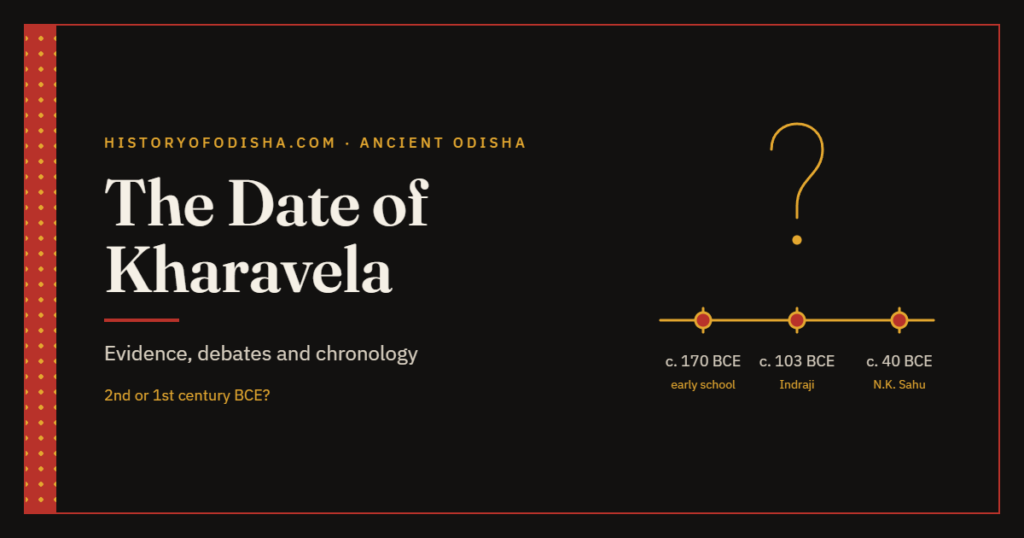
The date of Kharavela has been the subject of long debate. K.P. Jayaswal and R.D. Banerji placed his reign in the first half of the 2nd century BCE, partly on the basis of readings that linked him with the Indo-Greek king Demetrius and the Shunga king Pushyamitra. Bhagwan Lal Indraji suggested a date around 103 BCE. D.C. Sircar, on palaeographic grounds and in light of other inscriptions, placed the Hathigumpha inscription in the second half of the 1st century BCE or the early 1st century CE. (Live History India) The reading of 300 years, rather than 103, for the interval between a Nanda king’s canal and Kharavela’s fifth year also fits a 1st-century BCE date. Most recent scholars therefore favour the later chronology, which is adopted here.
The Kalinga Kharavela inherited
Kharavela came to the throne of a kingdom that had recovered from the trauma of the Mauryan conquest and regained its independence. Its heartland was the fertile delta of the Mahanadi, and its capital, Kalinganagari, is widely identified with the fortified city of Sisupalgarh near Bhubaneswar. Excavations have shown this to have been a large planned city, about 1.2 km on each side, with ramparts, a moat and monumental gateways, and an estimated population of 20,000–25,000. (Wikipedia: Sisupalgarh) The kingdom possessed ports, agricultural wealth and access to forest resources. To judge from the sums Kharavela was able to spend in his first year, it also had a well-filled treasury. The historian Amar Chand Mittal inferred that Kharavela must have inherited a rich treasury from his predecessor. (Mittal, An Early History of Orissa) The capital, however, had recently suffered damage from a storm, and the kingdom faced rivals on several sides. These included the Satavahanas in the Deccan, the peoples of the south, and the powers of the Gangetic plain.
2. Early Life and Education: The Making of a King
The Hathigumpha inscription devotes considerable attention to Kharavela’s early life, and this emphasis is itself significant. It shows that the composers of the inscription regarded education and preparation as essential qualifications for kingship.
According to the inscription, Kharavela spent his first fifteen years in the games and pastimes of youth, with a body described as ruddy and handsome. He then embarked on a period of formal training. He mastered royal correspondence (lekha), currency (rupa), accounts and finance (ganana), and the civil and religious laws (vyavahara and vidhi), and he became well versed in all branches of learning. For nine years he served as heir apparent (yuvaraja), presumably sharing in the administration of the kingdom under his predecessor. On completing his twenty-fourth year, he received the great royal consecration (maharajyabhisheka) in the dynasty of Kalinga. (Wikipedia: Hathigumpha inscription) B.M. Barua translated the five skills learnt by the crown prince as writing, coinage, accounting, administration and legal procedure.
This account reveals a carefully structured royal education that combined literacy and numeracy with knowledge of the economy, administration and law. It corresponds broadly to the stages of life prescribed in normative Indian texts, in which a period of learning precedes the assumption of adult responsibilities. It also implies a state with written records, a monetary system and a developed legal tradition. The long apprenticeship as yuvaraja would have given Kharavela practical experience of government before he became king. This may help to explain the vigour with which he acted from the first year of his reign.
The inscription also stresses Kharavela’s personal qualities: his auspicious bodily marks, his virtues, and his destiny for wide conquests comparable to those of the legendary king Vena. In later lines he is described as versed in the science of the Gandharvas, that is, music. (Wikipedia: Hathigumpha inscription) Such descriptions are conventional elements of royal eulogy, but they convey the ideal of a king who was physically impressive, morally virtuous, intellectually accomplished and culturally refined.
3. Career as a Conqueror
Kharavela’s reputation as a great conqueror rests on the military campaigns recorded in the Hathigumpha inscription. They are distributed over several years of his reign and directed towards every point of the compass except the sea. Their sequence reveals a deliberate pattern: campaigns abroad alternate with years of consolidation at home.
The western campaigns (years 2 and 4)
In his second regnal year, according to the reading of Jayaswal and Banerji, Kharavela sent westwards a large army of cavalry, elephants, infantry and chariots “disregarding Satakarni”. It reached the river Kanha-bemna and threw the city of the Musikas into consternation. (Wikipedia: Hathigumpha inscription) The Satakarni named here is generally identified as a ruler of the Satavahana dynasty of the Deccan. The Kanha-bemna has been identified with the Krishna or with the Kanhan–Wainganga system, and the Musikas have been located in various parts of the Deccan. Scholars differ on whether the phrase indicates defiance of Satakarni, a campaign that bypassed his territory, or even friendly relations. In his fourth year, Kharavela is said to have made the Rathikas and Bhojakas, peoples of the western Deccan, bow at his feet, stripping them of their crowns, umbrellas and jewels. Together these campaigns suggest that Kharavela sought to assert Kalinga’s power in the Deccan, a region dominated by the Satavahanas.
The northern campaigns (years 8 and 12)
In his eighth year, according to the same reading, Kharavela sacked Goradhagiri, usually identified with the Barabar hills in Bihar, and put pressure on Rajagriha, the ancient capital of Magadha. The damaged passage that follows was read by Jayaswal as describing the retreat of a Yavana (Greek) king named “Dimita” to Mathura. Jayaswal identified him with the Indo-Greek ruler Demetrius. Most scholars now consider this reading extremely doubtful. Ramaprasad Chanda and D.C. Sircar showed that the identification leads to chronological impossibilities, and Sailendra Nath Sen concluded that the Yavana ruler, if mentioned at all, was certainly not Demetrius. (Wikipedia: Hathigumpha inscription)
In his twelfth year, Kharavela is said to have terrified the kings of Uttarapatha, driven his elephants into Magadha and made its king, read as Bahasatimita, bow at his feet. He brought back the Kalinga Jina, carried off long before by a Nanda king, together with the treasures of Anga and Magadha. Early scholars identified Bahasatimita with the Shunga king Pushyamitra, but Sircar rejected this as chronologically impossible. (Wikipedia: Hathigumpha inscription) Whatever the identity of the Magadhan king, the recovery of the Kalinga Jina was a triumph of great symbolic importance. It reversed a humiliation inflicted on Kalinga by Magadha centuries earlier. It has also been seen as a symbolic reversal of the Mauryan conquest, though the inscription does not mention Ashoka.
The southern campaigns (years 11–13)
In his eleventh year, the inscription records the destruction of Pithunda, a city founded by an earlier king, which Kharavela had ploughed with asses as a mark of utter humiliation. In the same passage he is said to have broken up a confederacy of Tramira (Tamil) countries that had lasted 113 years and threatened Kalinga. Later he received horses, elephants, jewels and pearls from the Pandya king. (Wikipedia: Hathigumpha inscription) Pithunda is often identified with Ptolemy’s Pitundra in coastal Andhra Pradesh. The reference to a Tamil confederacy and to the Pandyas suggests that Kalinga’s interests extended far down the eastern seaboard. That may reflect maritime as well as land-based connections.
Summary of the campaigns
| Year | Direction | Claimed achievement | Reliability of reading |
|---|---|---|---|
| 2 | West | Army sent “disregarding Satakarni”; reaches the Kanha-bemna; alarms the city of the Musikas | Legible; identifications and meaning debated |
| 4 | West | Rathikas and Bhojakas made to submit | Partly legible |
| 8 | North | Goradhagiri sacked; pressure on Rajagriha; Yavana king said to retreat | Very uncertain; Yavana reading extremely doubtful |
| 10 | North | Expedition towards Bharatavasa | Uncertain |
| 11 | South | Pithunda destroyed; Tamil confederacy of 113 years broken up | Partly legible; identifications debated |
| 12 | North | Kings of Uttarapatha terrified; Magadha invaded; king “Bahasatimita” submits; Kalinga Jina recovered | Partly legible; identity of the king disputed |
| 12–13 | South | Gifts received from the Pandya king | Partly legible |
Assessment of the campaigns
The campaigns show that under Kharavela, Kalinga was able to project military power over great distances. The inscription’s references to armies of cavalry, elephants, infantry and chariots, the traditional four limbs of the Indian army, indicate a substantial and well-organised military establishment. Yet the historian must interpret these claims with caution. The inscription is a eulogy, and its language of submission, terror and humiliation is typical of royal panegyric. Raids, punitive expeditions and the receipt of gifts may have been presented as great conquests. There is no evidence that Kharavela established lasting rule over Magadha, the Deccan or the south. His achievement is better understood as the assertion of Kalinga’s power and prestige in the wider political world of his time than as the creation of a territorial empire.
4. Achievements as Builder and Administrator
If Kharavela’s military campaigns have attracted the most attention, his achievements at home are in some ways better attested. They are described in the well-preserved early lines of the inscription and reveal a ruler deeply concerned with the welfare and prosperity of his kingdom.
Urban renewal
Kharavela’s first act as king was to restore his capital. In his first regnal year he repaired the gates, walls and buildings of Kalinganagari, which had been damaged by a storm, and restored all its gardens. (Wikipedia: Hathigumpha inscription) The priority given to this work suggests both the practical importance of the capital’s defences and the symbolic importance of a splendid royal city. If Kalinganagari is correctly identified with Sisupalgarh, the massive ramparts and gateways revealed by excavation give a vivid idea of the scale of the structures Kharavela restored. In his ninth year he built a royal residence, the “Palace of Great Victory” (Mahavijaya-prasada), at a recorded cost of 3.8 million. The inscription also refers to the building of towers with carved interiors and to the settlement of a hundred masons, who were exempted from land revenue. This suggests a deliberate effort to foster skilled craftsmanship.
Water management
Some of Kharavela’s most important works concerned water. In his first year he built the embankments of a lake named after the sage Khibira, and of other tanks and cisterns. In his fifth year he extended into the capital, from the Tanasuliya road, a canal originally excavated by a Nanda king. (Wikipedia: Hathigumpha inscription) In a region dependent on the monsoon and subject to both floods and dry seasons, the storage and distribution of water were vital to agriculture and to urban life. Kharavela’s attention to these works places him in a long tradition of Indian rulers who regarded irrigation and water supply as a primary royal duty. His extension of the Nanda canal also shows awareness of earlier infrastructure and a willingness to build upon it.
Finance and fiscal relief
The inscription records large expenditures: 3.5 million on the works of the first year, 3.8 million on the palace, and, in the sixteenth line, a further 2.5 million on a structure with pillars inlaid with beryl. (Wikipedia: Hathigumpha inscription) The units are not specified, and the figures may be rounded or idealised, but they indicate a wealthy treasury and a monetised economy. Equally significant are the measures of fiscal relief. In his sixth year Kharavela remitted taxes and cesses and granted privileges worth hundreds of thousands to the urban and rural corporations (paura and janapada). Elsewhere he is said to have granted exemptions to Brahmins and to masons. These measures suggest a ruler who sought to win the support of his subjects through generosity, and who recognised the importance of organised urban and rural communities in the life of the kingdom.
An ideal of welfare kingship
Taken together, these achievements present Kharavela as a ruler who combined conquest with care for his people. The inscription repeatedly states that his acts “gratified” the people, and it describes him in its closing lines as the King of Peace and the King of Prosperity. This image is idealised, but it reflects a conception of kingship in which the ruler’s legitimacy rested not only on military success but also on his provision of security, infrastructure, relief and entertainment for his subjects.
5. Patron of Culture and Religion
Music, festivals and the arts
The Hathigumpha inscription describes Kharavela as versed in the science of the Gandharvas, that is, music and the performing arts. In his third regnal year he entertained his capital with performances of dance, singing and instrumental music, and with festivals and assemblies (utsava and samaja). The passage also mentions an entertainment the inscription calls dapa, which may refer to a dramatic performance or, in B.M. Barua’s alternative reading, to a form of combat or wrestling. (Wikipedia: Hathigumpha inscription) These entertainments were not merely private pleasures of the court. They were public occasions that bound the king to his subjects and displayed the prosperity and cultural refinement of the kingdom. The relief sculptures of the Udayagiri caves, with their dancers, musicians, processions and hunting scenes, give visual form to the courtly and urban culture the inscription describes.
Architecture and the caves of Udayagiri and Khandagiri
Kharavela’s most enduring cultural legacy lies in the rock-cut caves of the Udayagiri and Khandagiri hills near Bhubaneswar. In his thirteenth year, according to the inscription, he caused shelters to be excavated for Jain monks on the Kumari hill, the ancient name of Udayagiri. (Wikipedia: Hathigumpha inscription) The caves of these hills, excavated under Kharavela and his family and successors, include the magnificent two-storeyed Rani Gumpha with its long sculptured friezes, the Ganesh Gumpha, and the Manchapuri cave with the inscriptions of Kharavela’s chief queen and of his successor Kudepasiri. They are among the earliest groups of rock-cut monastic architecture in India and the finest early monuments of eastern India. The settlement of a hundred masons with tax exemptions, mentioned in the inscription, may be connected with the creation of these caves and of other royal buildings.
Devotion to Jainism
Kharavela was a devout Jain, and the Hathigumpha inscription is a Jain document. It opens with the salutation to the Arhats and to all the Siddhas, the Namokar formula. It describes the king as a lay devotee who had realised the nature of soul and body (jiva and deha). (Wikipedia: Hathigumpha inscription) His religious achievements, as recorded in the inscription, were considerable. On the Kumari hill, where the wheel of the Jina’s teaching had turned, he offered maintenance and garments to the monks. He convened an assembly of ascetics and sages from all quarters near the relic depository of the Arhat on the hill. He also caused the seven-fold Angas, the Jain canonical texts, to be compiled. His recovery of the Kalinga Jina from Magadha was the supreme expression of his piety. Through it he restored to Kalinga an object sacred to its Jain community that had been lost since the time of the Nandas.
These achievements made Kharavela’s reign the high point of Jainism in ancient Odisha. They also give the inscription a special significance for the history of Jainism in India as a whole. The references to the compilation of the Angas and to an assembly of monks have been studied by historians of the Jain canon. The question of whether the Kalinga Jina was an anthropomorphic image has implications for the history of Jain image worship. Sonya Quintanilla has argued that the absence of anthropomorphic Jain images in this period, and the non-figural worship depicted in the nearby Manchapuri cave, make it unlikely that an idol is meant. (Wikipedia: Hathigumpha inscription)
Respect for all sects
Remarkably, the same inscription that celebrates Kharavela’s devotion to Jainism also describes him as a respecter of every sect (sava-pasamda-pujaka) and a repairer of all temples (sava-devayatana-samkhara-karaka). It also records gifts and exemptions granted to Brahmins. (Wikipedia: Hathigumpha inscription) This combination of personal faith and public impartiality reflects a well-established ideal of Indian kingship. Ashoka had earlier proclaimed respect for all sects, and many later rulers would do the same. It suggests that Kharavela understood the political value, as well as the moral merit, of maintaining good relations with all the religious communities of his kingdom.
6. Kharavela as a Ruler: An Assessment
The ideal of kingship in the Hathigumpha inscription
The closing lines of the Hathigumpha inscription sum up the image of Kharavela that his eulogists wished to convey. He is the King of Peace (khema-raja), the King of Prosperity (vadha-raja), the King of Monks (bhikhu-raja) and the King of Dharma (dhama-raja). He is accomplished in extraordinary virtues, a respecter of every sect, a repairer of all temples, one whose chariot and army are irresistible, and a descendant of the royal sage Vasu. (Wikipedia: Hathigumpha inscription) This sequence of titles combines several ideals at once. There is the universal conqueror whose armies cannot be resisted, the welfare king who brings peace and prosperity, the pious patron of religion, and the impartial protector of all faiths. The inscription thus presents an early and influential formulation of the ideal Indian monarch. It is one of the first examples of the prashasti genre that would reach its classic form in later royal eulogies such as Harishena’s praise of Samudragupta on the Allahabad pillar.
Kharavela and Ashoka
It is natural to compare Kharavela with Ashoka, the conqueror of Kalinga, and the comparison is illuminating. Both rulers combined political power with religious devotion, Ashoka to Buddhism and Kharavela to Jainism. Both proclaimed respect for all religious sects, and both used inscriptions to communicate their achievements and ideals. Yet their attitudes to war were very different. Ashoka, after the Kalinga War, publicly renounced conquest by arms and sought conquest by dhamma. Kharavela, by contrast, celebrated his military victories without any hint of regret, and he presented conquest and piety as complementary aspects of good kingship. Kharavela’s inscription, moreover, is a record composed in praise of the king. Ashoka’s edicts are largely addressed to his subjects and officials in his own voice, and they are concerned above all with moral instruction. The two rulers thus represent two distinct models of kingship in ancient India, both of which proved influential in later centuries. Notably, the Hathigumpha inscription makes no mention of Ashoka or the Kalinga War. This silence has been interpreted variously, but it should not be overinterpreted, since the inscription is concerned with Kharavela’s own achievements rather than with the history of his kingdom.
A balanced assessment
What, then, can be said with confidence about Kharavela as a ruler? The well-preserved portions of the inscription establish beyond doubt that he was a vigorous and wealthy king. He undertook major public works, especially in water management and urban renewal. He granted fiscal relief to his subjects and patronised the arts and festivals. He was a devoted supporter of Jainism who also honoured other faiths, and he led military expeditions far beyond Kalinga’s borders. The great caves of Udayagiri and Khandagiri stand as material testimony to the resources and cultural ambitions of his reign.
The more expansive claims made for Kharavela should, however, be treated with caution. These include his supposed defeat of a Greek king, his humbling of a particular Magadhan ruler, and the extent of his dominion. They rest on damaged and disputed portions of the inscription, and the inscription itself is a eulogy. Kharavela is best seen not as the ruler of a vast empire but as an exceptionally able and ambitious king, under whom Kalinga reached the height of its power and prestige in the post-Mauryan period.
Odia Historians on Kharavela’s Career
No ancient ruler has received more attention from Odia historians than Kharavela. Odia scholarship has offered detailed and often distinctive interpretations of his campaigns, his administration and his significance. It has also played a decisive role in establishing Kharavela as a symbol of Odisha’s historical identity.
N.K. Sahu: the campaigns reconstructed
Nabin Kumar Sahu‘s account in the Utkal University History of Orissa, vol. 1 (1964), remains the most detailed Odia reconstruction of Kharavela’s career. It differs from the Jayaswal–Banerji reading on several points. (Wikipedia: Kharavela, summarising Sahu 1964)
- The western campaigns. Sahu identified the “abode of the Vidyadharas”, which Kharavela attacked in his fourth year, with the eighteen forest kingdoms of the Allahabad pillar inscription and the eighteen Vidyadhara settlements of Jain tradition. He also suggested that the Maharathi Tranakayira, father-in-law of the Satavahana king Satakarni I, was probably the chief of the Rathikas whom Kharavela defeated. He argued that a war with the Rathikas and Bhojakas could not have taken place without an encounter with Satavahana power. As a result, in his view, Kharavela’s suzerainty extended across the Deccan “from sea to sea”.
- The northern campaigns. Sahu interpreted the eighth-year campaign as one in which Kharavela, after storming Goradhagiri and threatening Rajagriha, turned his attention to the north-west, where a Yavana ruler retreated to Mathura. Magadha was therefore spared that year. He described Bahasatimita, whom Kharavela humbled in his twelfth year, as ruling over Anga, Magadha, Vatsa (Kaushambi) and Panchala (Ahichchhatra).
- The southern campaign. Sahu identified the Tamil confederacy broken up by Kharavela with the Cholas, Pandyas, Satyaputras, Keralaputras and Tamraparni (Sri Lanka). He noted that Ashoka’s edicts show these states had never been subdued by the Nandas or the Mauryas, which in his reading made Kharavela’s victory over them especially significant.
Sahu placed Kharavela’s consecration around 40 BCE and the last known date of his career around 27 BCE, as discussed in the companion article on the date of Kharavela. (N.K. Sahu, OHRJ XLVII(3))
K.C. Panigrahi and the general histories
Krushna Chandra Panigrahi‘s History of Orissa (1986) presented Kharavela as a conqueror who led victorious expeditions against Magadha, the Satavahanas, the Tamil confederacy led by the Pandyas, and the Rathikas and Bhojakas. It also emphasised his public works and his remission of taxes and provision of festivities for his people. (Wikipedia: Kharavela, citing Panigrahi 1986) H.K. Mahtab‘s History of Orissa likewise gave Kharavela a central place in the narrative of ancient Odisha.
Kharavela as a symbol of Odia identity
Odia historians have consistently emphasised Kharavela’s significance for regional identity. Manmatha Nath Das (Glimpses of Kalinga History, 1949) saw his reign as the culmination of Kalinga’s remarkable revival after the Mauryan conquest. Kailash Chandra Dash, in Aira Mahameghavahana Maharaja Kharavela: The Illustrious King of Early Odisha, describes Kharavela as the greatest king of early Kalinga and an unmistakable symbol of Odia identity in its early phase. He acknowledges N.K. Sahu’s encouragement to study Kharavela in order to highlight Odisha’s place in the comprehensive history of India. (Exotic India: K.C. Dash, Aira Mahameghavahana Maharaja Kharavela) Sadananda Agrawal‘s Sri Kharavela (Cuttack, 2000), published by the Digambar Jain community of Cuttack, presents Kharavela in both regional and Jain perspectives. It draws on the works of Mahtab, Sahu, Panigrahi and R.P. Mohapatra. (Agrawal, Sri Kharavela, bibliography, JainQQ) The History of Odisha website, edited by Brajabandhu Mahanta, has presented Kharavela’s achievements in two phases, as a conqueror and as a benevolent ruler. It has also reprinted the Odisha Review debates on his date. (History of Odisha: Kharavela)
Assessment
Odia scholarship has made Kharavela one of the best-studied rulers of early India. N.K. Sahu’s detailed reconstruction, in particular, remains a standard reference. At the same time, some of the more expansive interpretations in this tradition depend on readings of damaged passages that other scholars question. Examples are Kharavela’s suzerainty over the Deccan “from sea to sea” and the full membership of the Tamil confederacy. The research scholar should therefore read Odia accounts alongside the critical editions of the inscription and the wider scholarly debate.
| Historian | Work | Principal interpretation of Kharavela’s career |
|---|---|---|
| Manmatha Nath Das | Glimpses of Kalinga History (1949) | Kharavela’s reign as the culmination of Kalinga’s revival |
| N.K. Sahu | Utkal University History of Orissa, vol. 1 (1964); Kharavela (1984) | Detailed campaign reconstruction; suzerainty over the Deccan; Tamil confederacy of Cholas, Pandyas, Satyaputras, Keralaputras and Tamraparni |
| K.C. Panigrahi | History of Orissa (1986) | Kharavela as conqueror and benevolent ruler |
| H.K. Mahtab | History of Orissa | Kharavela as a central figure of ancient Odisha |
| Sadananda Agrawal | Sri Kharavela (2000) | Regional and Jain perspectives |
| Kailash Chandra Dash | Aira Mahameghavahana Maharaja Kharavela | Kharavela as a symbol of early Odia identity |
| Brajabandhu Mahanta | History of Odisha website | Achievements as conqueror and benevolent ruler; dissemination of the Odisha Review debates |
7. Legacy and Debates
Legacy
Kharavela’s political achievements did not create a lasting empire. His successor Kudepasiri is known from a cave inscription, but the Mahameghavahana line in Kalinga soon disappears from the record. His cultural and religious legacy was more enduring. The caves of Udayagiri and Khandagiri remained a centre of Jain monasticism and pilgrimage for many centuries, and they continue to be revered today. The Hathigumpha inscription, rediscovered in the 19th century, has become one of the most studied documents of ancient Indian history. It is valued for its information about Kalinga and also for its references to the Satavahanas, the Nandas, Magadha and the south, and for its place in the development of royal eulogy.
In modern Odisha, Kharavela has acquired a special place in historical memory. He is celebrated as the ruler who restored Kalinga’s greatness after the Mauryan conquest, and his expedition to Magadha and recovery of the Kalinga Jina are often seen as a symbolic reversal of Ashoka’s victory. His patronage of Jainism and the arts has made him a symbol of the region’s cultural achievement. His name has been given to institutions, his statue stands in public places, and his inscription is regarded as a foundational document of Odia history.
Debates
Several questions about Kharavela remain unresolved.
His date continues to be debated, with proposals ranging from the early 2nd century BCE to the early 1st century CE. The choice affects not only Kalinga’s history but also the chronology of the Satavahanas and of early Indian art. Walter Spink argued that the early dating of Kharavela led to the misdating of many early Buddhist monuments in the Deccan by two or three centuries. (Wikipedia: Hathigumpha inscription)
His relationship with the Satavahanas depends on how the phrase concerning Satakarni is read. Different scholars interpret it as hostility, avoidance or alliance.
The identities of the rulers and places mentioned in the inscription, including the Yavana king, Bahasatimita, the Musikas, Pithunda and the Tamil confederacy, remain uncertain. Several of the readings on which they depend are disputed.
The nature of the Kalinga Jina, whether an image, a seat or another sacred object, is debated by historians of Jainism.
The extent of his power is interpreted very differently by those who see him as an imperial ruler and those who see his campaigns as raids recorded in panegyric language.
These debates do not diminish Kharavela’s historical importance. They reflect the challenge of interpreting a unique but damaged source, and they remind the research scholar to state clearly which readings and interpretations underlie any account of his reign.
Conclusion
Kharavela stands out among the rulers of ancient India as a king whose life and achievements are recorded in his own inscription, year by year. His career, as described in the Hathigumpha inscription, combined a thorough preparation for kingship, a programme of public works and fiscal relief, sustained patronage of music, festivals and architecture, devout support for Jainism alongside respect for all faiths, and military campaigns that carried the armies of Kalinga to the Deccan, the south and Magadha. Under his rule, Kalinga reached the height of its power and prestige in the post-Mauryan age.
At the same time, the historian must remember that this portrait is drawn by Kharavela’s own eulogists and preserved in a damaged text that can be read in many ways. His achievements at home, recorded in the better-preserved lines, are more secure than some of his more dramatic foreign victories. A balanced assessment recognises Kharavela as an exceptionally capable ruler and a major patron of culture and religion, whose reign marks the first great flowering of a distinctly Kalingan political and cultural identity. It also acknowledges the uncertainties that surround many details of his career.
Summary of Kharavela’s Achievements
| Field | Achievement | Evidence and certainty |
|---|---|---|
| Education | Trained in writing, currency, accounts and law; nine years as heir apparent; crowned at 24 | Lines 1–3; well preserved |
| Urban renewal | Repair of the capital’s gates, walls and buildings; restoration of gardens; Mahavijaya palace | Lines 3 and 10; first well preserved, latter partly |
| Water management | Embankments of the Khibira lake and other tanks; extension of the Nanda canal | Lines 3 and 6; well preserved |
| Fiscal relief | Remission of taxes; privileges to urban and rural corporations; exemptions for Brahmins and masons | Lines 6–7, 9, 13; partly preserved |
| Culture | Music, dance, festivals and assemblies for the capital | Line 5; well preserved |
| Military | Campaigns to the west (Satakarni, Musikas, Rathikas, Bhojakas), north (Magadha) and south (Pithunda, Tamil confederacy, Pandyas) | Lines 4–14; partly preserved; many details disputed |
| Religion | Recovery of the Kalinga Jina; support of Jain monks; assembly of ascetics; compilation of Jain texts | Lines 12–16; partly preserved |
| Architecture | Excavation of shelters for monks on the Kumari hill (Udayagiri) | Line 14–15; supported by the surviving caves |
| Tolerance | Respect for all sects; repair of all temples | Line 17; partly preserved |
Glossary of Technical Terms
| Term | Meaning |
|---|---|
| Prashasti | A eulogy of a king in an inscription |
| Yuvaraja | Heir apparent |
| Maharajyabhisheka | Royal consecration |
| Lekha, rupa, ganana, vyavahara, vidhi | Correspondence, currency, accounts, civil law and religious law, the subjects of royal education |
| Paura and janapada | Urban and rural corporations or communities |
| Samaja | Public assembly or festival |
| Gandharva-veda | The science of music and the performing arts |
| Kalinganagari | Kharavela’s capital, often identified with Sisupalgarh |
| Kalinga Jina | A Jain sacred object or image recovered from Magadha |
| Kumari hill | Ancient name of the Udayagiri hill |
| Angas | The principal texts of the Jain canon |
| Khema-raja, dhama-raja | “King of Peace”, “King of Dharma”: titles of Kharavela |
Frequently Asked Questions (FAQ)
1. Who was Kharavela? Kharavela was the third and greatest king of the Mahameghavahana dynasty of Kalinga, probably in the 1st century BCE. He is known from his Hathigumpha inscription at Udayagiri near Bhubaneswar.
2. At what age did Kharavela become king? According to the Hathigumpha inscription, he was consecrated king on completing his twenty-fourth year, after nine years as heir apparent.
3. What were Kharavela’s main military achievements? He led campaigns to the west against the Musikas, Rathikas and Bhojakas, to the north into Magadha, and to the south against Pithunda and a Tamil confederacy. Many details of these campaigns are disputed.
4. What public works did Kharavela undertake? He repaired his capital after a storm, built embankments for lakes and reservoirs, extended an old canal into the capital, and built a palace.
5. What religion did Kharavela follow? He was a devout Jain, but he also declared respect for all religious sects and repaired all temples.
6. What is the Kalinga Jina? It was a Jain sacred object, often understood as an image, which had been taken to Magadha by a Nanda king and was brought back to Kalinga by Kharavela.
7. How did Kharavela differ from Ashoka? Both combined political power with religious devotion and tolerance. But Ashoka renounced war after Kalinga, whereas Kharavela celebrated his military victories as part of ideal kingship.
How to Cite This Article
History of Odisha. “Kharavela: Career and Achievements.” historyofodisha.com, 2026. https://historyofodisha.com/kharavela-career-and-achievements/ (accessed [date]).
This article is a survey intended as a guide. For research, cite the scholarly editions of the Hathigumpha inscription and the specialist studies listed below directly.
Sources and Further Reading
Web sources consulted
- Hathigumpha inscription — Wikipedia
- Kharavela — Wikipedia
- Minor Inscriptions of Kharavela — Wikipedia
- Sisupalgarh — Wikipedia
- Kalinga’s King Kharavela — Live History India
- Kharavela — History of Odisha
- A.C. Mittal, An Early History of Orissa — JainQQ
- Udayagiri Cave Complex: Hathigumpha and King Kharavela — Puratattva
Epigraphic editions and specialist studies
- K.P. Jayaswal and R.D. Banerji, “The Hathigumpha Inscription of Kharavela”, Epigraphia Indica, vol. 20 (1929–30), pp. 71–89
- B.M. Barua, Old Brahmi Inscriptions in the Udayagiri and Khandagiri Caves (University of Calcutta, 1929); “Hathigumpha Inscription of Kharavela”, Indian Historical Quarterly 14 (1938)
- D.C. Sircar, Select Inscriptions Bearing on Indian History and Civilization, vol. 1 (University of Calcutta, 1965), no. 91
- Shashi Kant, The Hathigumpha Inscription of Kharavela and the Bhabru Edict of Asoka: A Critical Study (1971; 2nd edn 2000)
- Richard Salomon, Indian Epigraphy (Oxford University Press, 1998)
- Walter Spink, “On the Development of Early Buddhist Art in India”, The Art Bulletin 40(2) (1958)
- Sonya Rhie Quintanilla, History of Early Stone Sculpture at Mathura, ca. 150 BCE–100 CE (Brill, 2007)
Standard books
- R.D. Banerji, History of Orissa, vol. 1 (1930)
- N.K. Sahu (ed.), History of Orissa, Vol. I, Utkal University
- K.C. Panigrahi, History of Orissa (Hindu Period)
- Sadananda Agrawal, Sri Kharavela (Cuttack, 2000)
- Romila Thapar, Early India: From the Origins to AD 1300 (2002)
- Upinder Singh, A History of Ancient and Early Medieval India (Pearson, 2008)
Works by Odia historians
- Manmatha Nath Das, Glimpses of Kalinga History (Calcutta, 1949)
- N.K. Sahu (ed.), History of Orissa, vol. 1 (Utkal University, 1964)
- N.K. Sahu, Kharavela (Orissa State Museum, 1984)
- N.K. Sahu, “Palaeography, Language and Art of Hatigumpha Inscription”, Orissa Historical Research Journal XLVII(3)
- K.C. Panigrahi, History of Orissa (1986)
- H.K. Mahtab, History of Orissa
- Kailash Chandra Dash, Aira Mahameghavahana Maharaja Kharavela: The Illustrious King of Early Odisha
- R.P. Mohapatra, Udayagiri and Khandagiri Caves
- Gouri Shankar Tripathy, “Date Line of Kharavela the Great”, Odisha Review, November 2008